The illicit tobacco market: a reply to ASH
The government and ASH can continue to bury their heads in the sand, but the truth is becoming inescapable.


Earlier this month I reported that legal cigarette sales fell by 52% between 2021 and 2025 in the UK. These are official clearance figures from HMRC and show a rate of decline which far outstrips any estimate of the decline in smoking. The conclusion is obvious: more and more smokers are buying tobacco from illicit sources.
The state-funded pressure group Action on Smoking and Health (ASH) have responded by claiming that things are not as bad as they look. The accelerated decline since 2021 is, they say, “consistent with a long-term downward trend”. While they acknowledge that “the illicit trade may also be a factor” and that “ongoing cost of living pressures may have pushed some smokers, particularly those on lower incomes, to seek out cheaper, illicit alternatives”, they insist that “declining tobacco clearances appear to be driven mainly by falling smoking prevalence and reduced consumption among those who still smoke”.
As evidence, they have created a graph showing legal cigarette sales since 2015. This seems to show a fairly steady longterm decline, albeit interrupted by the COVID-19 pandemic, with sales in 2025 only slightly lower than one might expect.
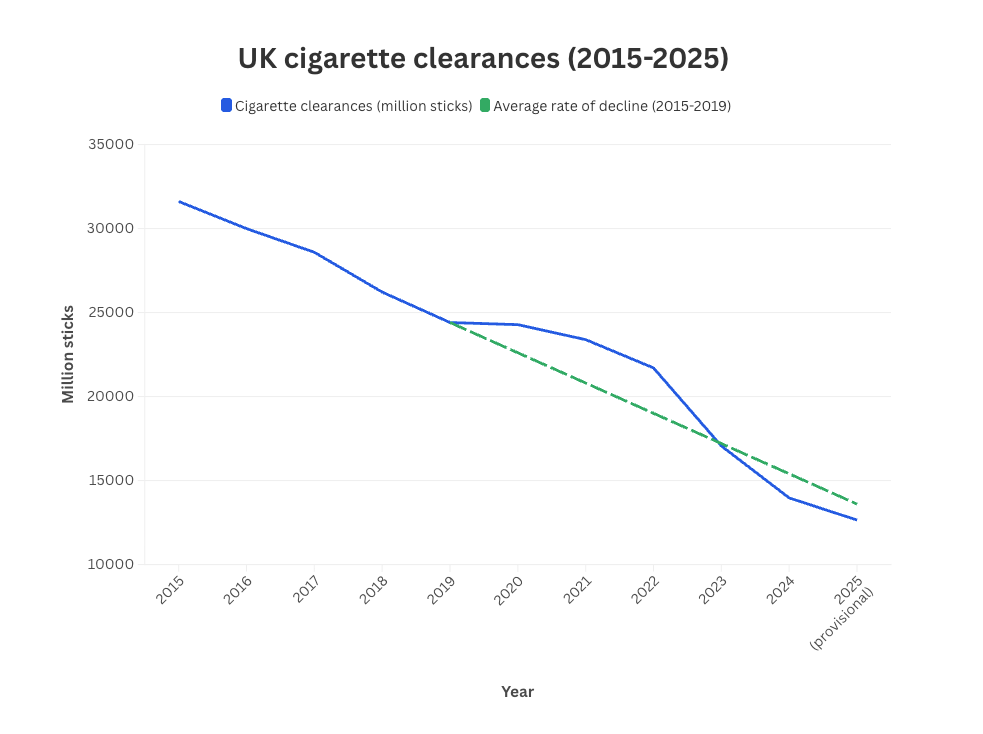
You will notice that the decline in legal sales slowed significantly during the pandemic. ASH say, rather cryptically, that the pandemic “disrupted smoking behaviour, coinciding with a spike in tobacco purchasing which has since faded”. What form did this disruption take? Did the number of smokers increase? No. Office for National Statistics figures show that the smoking rate fell from 14.1% to 11.7% between 2019 and 2022. Did smokers consume more cigarettes? No. A study published in 2024 found that the number of cigarettes smoked by the average smoker “remained stable” between October 2019 and 2023 (note that this contradicts ASH’s assertion that there has been “reduced consumption among those who still smoke”).
The best explanation for the increase in legal sales relative to the number of smokers during the pandemic is that lockdowns and travel bans prevented people from buying tobacco abroad and hindered the ability of black market traders to import and sell illicit tobacco. The hump shown in ASH’s graph between 2020 and 2022 reflects smokers being temporarily unable to access non-duty paid tobacco, both legal and illegal. It is further evidence that Britain has a large black market in tobacco.
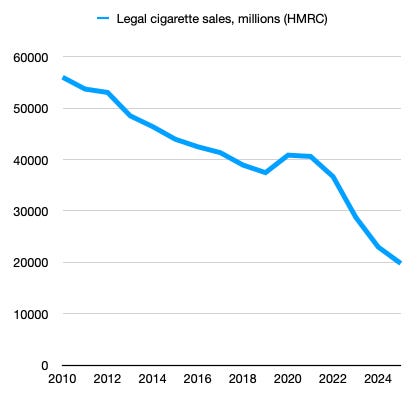
This is even more apparent if you include the sale of rolling tobacco, which ASH fail to do. By only looking at manufactured cigarettes, they miss an important part of the market and a very important part of the black market. Legal sales of rolling tobacco actually rose during the pandemic, from 6.5 million kilograms in 2019 to 8.6 million kilograms in 2021. If you translate kilograms of rolling tobacco into cigarettes at a conversion rate of 2,000 cigarettes per kilogram, we find that the sale of legal cigarettes rose by 8% during the pandemic. When opportunities to buy illicit and duty-free tobacco returned to normal in 2022, legal sales began to fall sharply. It doesn’t really matter whether you use 2021 or 2022 as the baseline. The former gives a decline of 52% while the latter gives a decline of 46%. Both figures comfortably outstrip the decline in the number of smokers and therefore the number of cigarettes actually being smoked.
When we look at total cigarette sales, including cigarettes made from rolling tobacco, the post-2021 decline is much more dramatic than ASH make it look. This was a period of large, successive increases in tobacco duty which hit users of rolling tobacco particularly hard. A growing number of smokers were priced out of the legitimate market. As the graph below shows, the steep decline in legal sales in recent years far exceeds both the longterm trend and the decline in the number of smokers.
ASH cite a study which they say shows that “the vast majority of smokers do not buy illicit”, but that is based on a telephone survey and it has no data since 2022. For obvious reasons, people may not be willing to admit to engaging in illegal transactions with a stranger over the phone, and the kind of people who are most likely to buy illicit tobacco may be the least willing to take part in a survey, but the survey still found that the number of smokers who buy tobacco abroad (legally or illegally) trebled between 2019 and 2022, albeit with a sharp decline during the pandemic.
“HMRC’s flawed estimates have given a fig leaf to groups like ASH to hide the true scale of Britain’s black market tobacco problem.”
ASH also cite HMRC’s tobacco gap estimates which, they say, show that “illicit tobacco consumption is stable as of 2023/24 and has declined substantially over the long term”. But the whole point of my article was that HMRC’s estimates are wrong. The claim that the tax gap is only 13.8% is not consistent with any of the data on legal sales and cigarette consumption. The Office for Statistics Regulation has expressed concerns about the methodology and even HMRC says that its estimate has “high uncertainty”.
HMRC’s flawed estimates have given a fig leaf to groups like ASH to hide the true scale of Britain’s black market tobacco problem. It is a problem that has become increasingly visible on the high street, in empty pack surveys, and in the simple mathematics outlined above. It is simply not possible for legal sales to be falling so much faster than cigarette consumption without the black market growing at pace. The government and ASH can continue to bury their heads in the sand, but the truth is becoming inescapable.
 | A guest post by
|
It is now in ASH and HMRC's court to respond to a well argued case. Widening the argument, I have a hypothesis that the growth of stress related illnesses in recent times is an unintended consequence of the restrictions on smoking. (Comment by someone who has never smoked).