

Legal tobacco sales halve in four years as black market booms
New figures are proof that Britain has a major problem with the illicit trade


An analysis of new figures from HMRC reveals that legal tobacco sales fell by 52% in the United Kingdom between 2021 and 2025. The volume of manufactured cigarettes sold dropped by 46%, from 23.4 billion sticks to 12.6 billion sticks, while the volume of rolling tobacco fell by 59%, from 8.6 million kilograms to 3.6 million kilograms.
The decline in legal rolling tobacco sales is particularly significant because loose tobacco has been subject to the heaviest tax rises in recent years, with the duty rate doubling since 2020. Rolling tobacco is often the last resort for low income smokers before they turn to the black market.
Converting kilograms of rolling tobacco into sticks, we find that a total of 19.8 billion cigarettes were sold legally in the UK in 2025, less than half the figure recorded in 2021 (40.6 billion).1 This decline is far greater than any estimate of the decline in the smoking rate. These estimates vary. According to the Opinion & Lifestyle Survey, the smoking rate among people aged 16 or older in Great Britain fell from 12.7% to 9.1% between 2021 and 2024. According to the Annual Population Survey, the rate among people aged 18 or older in the United Kingdom fell from 12.3% to 10.5% in the same period. Neither survey has an estimate for 2025 yet, but the monthly Smoking Toolkit Study suggests that the rate of daily cigarette smoking in England was 10.6% in 2025, only modestly less than in 2021 when the rate was 11.4%.
“there is a large and growing market for illicit cigarettes.”
Using the UK-wide figures from the Annual Population Survey below, we can see that the downward trajectory of legal cigarette sales has been far steeper than that of the number of smokers.
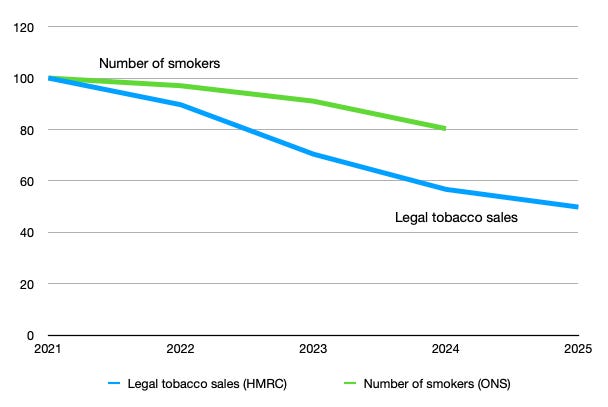
We know from other surveys that the number of cigarettes consumed per smoker has not changed in recent years. The conclusion is therefore inescapable: there is a large and growing market for illicit cigarettes.
The most obvious explanation for this is that smokers have been priced out of the legitimate market by taxation. Since 2020, there have been seven increases in tobacco duty. The minimum excise tax on cigarettes has risen by 61%, the specific excise tax on cigarettes has risen by 73%, and the tax on rolling tobacco has risen by 115%. In a classic example of the Laffer Curve, these tax hikes have not led to increased revenue. Instead they have led to total tobacco duty revenue falling from £10.4 billion to £7.9 billion since 2021.
The government appears to have its head in the sand on this issue. HMRC’s official estimates of the tobacco tax gap are deeply flawed and defy belief. Its most recent estimate is that 13.8% of tobacco sales were “non-duty paid” in 2023/24, and yet it seems clear from the data above that the illicit sector has taken more market share than that in the last five years alone. Almost unbelievably, HMRC claims that the illicit share of the rolling tobacco market is at an all-time low of 22.9%.
The Office for Statistics Regulation has announced a review into the quality of HMRC’s statistics and has asked it to “monitor whether its methods are optimally capturing tax gap and market size information”. In the meantime, flawed tax gap estimates breed complacency among politicians who are currently eyeing up incremental prohibition in the form of the Tobacco and Vapes Bill. Speaking in the House of Lords last week, Lord Bethell said that he was deeply sceptical of “stories about the black market” and complained, somewhat ironically, about the “loose use of numbers in the description of illicit trade”.
The explosion of black market tobacco in recent years will not come as news to smokers, nor to anyone who pays attention to cigarette packs on the pavement and in beer gardens, but the dramatic decline in legal sales at a time when the number of smokers has been falling more modestly, is conclusive proof that we have a serious problem.
 | A guest post by
|
Yes you are correct Christopher. Of course the poor will turn to the black market for their cigarettes. Especially on price. Bit more do as foreign immigration increases bringing in supply lines with them for such goods.
It’s not a surprise giving the cost of vat and duty combined. And of course profiteering by illegal business and legitimate business alike.
This black market is as old as the hills. And it won’t ever stop unless we take back control of our money and swap old notes and coins and digital sterling here and abroad with a uk based smart card banking system that can take its place. Then we can have a track and trace system to outlaw for good such ability to practice.
When will they understand? Our monetary system only works when money moves. In particular when money is SPENT. As that’s the trigger point for tax.
As an employer SPENDS on their employee then that is the trigger point for tax, income tax and Nic. And again when the employee SPENDS on themselves vat and duty are triggered.
So it’s plainly obvious Christopher that all our major taxes are triggered by SPENDING and the movement of money. Without money and without that money bring SPENT then there is no tax!
So money flow is the key to growth and prosperity. Reduced SPENDING and s lack of money bring SPENT to supply our own pockets us the cause of our stagnation.
Do if they can control money. Keep it in house in the uk by reintroducing exchange controls and in so doing swap all old money for new digital money we can ensure a back market can never exist.
More flow and more weight of the money already in existence in a quicker time will give us the growth we are all desperate for.