

Blair vs Burnham
Plus: Evolutionary economics and NEETs surge

In today’s newsletter:
Escalating energy prices
NEETs surge
Gen Z want growth
It is the burden of most Prime Ministers to suffer criticism from their predecessors, who are invariably convinced that their own unimpeachable leadership was laid low only by ill fortune and treacherous colleagues. It is more unusual for this to happen before they’ve started.
In this context there was a thoughtful exchange this week between former Prime Minister Tony Blair, and Andy Burnham, Labour by-election candidate (other party candidates are available), Mayor of Manchester, and commentariat anointed future PM after an assumed win then successful leadership challenge to the incumbent Sir Keir Starmer.
The politics are for the politicians, and elections for the voters, but this was also interesting for what it said about policy. Blair’s remedy, set out in a 5,700 word essay, was a case for pragmatism with a focus on economic growth, centred on being ready for the AI “ 21st century industrial revolution”. He believes current politics is both too ideological and simultaneously too trivial. An easy case to make when the Government is prioritising Russian imports of fossil fuels over opening up North Sea fields while prices rise, some are banging on about rejoining the EU, and the Chancellor is offering VAT discounts on funfair tickets as a treat for the summer. He worries his own party, particularly its left-wing has “an infinite capacity for self-delusion”. Consistently reaching for more tax and spending and pleasing interest groups, rather than confronting difficult choices.
It is a typically Third Way plea from the Radical Centre: not for more government, but for more capable government; fiscal discipline; education reform; welfare reform including the triple lock; effective border control alongside high-skilled migration; planning reform; and a shift from prioritising “clean energy” to prioritising “cheap energy”.
Burnham’s lighter response, around a quarter of the length, puts the high cost of living at the heart of his analysis of what is wrong with politics. He specifically blames “40 years of neoliberalism”, meaning deregulation – particularly around the 2008 financial crisis, selling off council houses (right to buy), and insufficient attention to regional inequality. He wants to be “place-first” not “party-first”.
He believes the solution is “Good Growth” through decentralised state investment and local public control of infrastructure like “transport, energy, water” or services like “education and housing”. He does not believe this can be “left to the market” and would use more “social value weighting” over “lowest price” criteria to judge procurement bids. He’s fond of the state owning buses. This repeats his January speech on “Manchesterism”, which the IEA covered at the time.
He also criticises Blair’s approach to education, which upped university places to the claimed neglect of technical places. He notes that AI is something of a leveller between the two. He makes a nod to fixing the Home Office and keeping the current line on migration. Blair challenged the alleged contestants for the top job to be “problem solvers” not “problem managers” and Burnham believes that’s what he is. Look at the buses.
From a classical liberal economic perspective there will clearly be more sympathy for Blair’s analysis over Burnham’s. But both are offering versions of the ‘enabling state’ argument, Blair’s AI-led technocracy restoring Britain’s place in the world versus Burnham’s Mayor-led bureaucracy lifting living standards one council estate or tram link at a time. Both dodging the harder questions of what the state is for and whether helping is actually helping.
The weaker case however remains Burnham’s, correctly identifying the cost of living as a driver of public discontent while failing to demonstrate how his approach would reduce those costs. Decentralisation is rarely done to save money, and each new tier creates an interest group determined to expand their own budget. While his egalitarian instincts to redistribute national income to places falling behind will undermine political incentives to promote local growth.
Whether any of this matters will remain unknowable until the political manoeuvring settles. In the meantime Sir Keir Starmer has published his own response to Blair. It’s on Substack and doesn’t mention buses.
Andy Mayer
Energy Analyst
The best way to never miss out on IEA work, get access to exclusive content, and support our research and educational programmes is to become a paid IEA Insider.
IEA Podcast: Director of Communications Callum Price and Managing Editor Daniel Freeman are joined by Senior Economist Valentin Boboc to discuss Tony Blair’s plan for Britain, NEETs, and Reform’s latest tax cut - IEA YouTube
Cost of renewables to double by 2030
Subsidies and grid integration costs are on course to double from £19.8 billion in 2024/25 to £40.1 billion in 2030/31 — equivalent to around £700 per household — regardless of what happens to gas prices
Conservative and Reform proposals to cancel AR7, abolish the Renewables Obligation and eliminate carbon taxes would save around £12.1 billion per year — but still leave subsidies and electricity system costs £8.2 billion above the 2024/25 baseline by 2030/31
The Government’s claim that clean energy will reduce bills is false: grid integration costs alone are set to rise by £17 billion, dwarfing any savings from lower wholesale gas prices, argues energy expert David Turver in a new post for the Institute of Economic Affairs

Watch David Turver discuss escalating energy prices with Andy Mayer, IEA YouTube
News and Views
New Report: Evolutionary Economics
In a new paper, academic Dr Erik Lidström argues that there is a fundamental mismatch between the world our brains evolved in to, and the society we operate in today.
“All over the world, we face many serious economic and social challenges. Apart from the immediate effects of cycles of boom and bust, we experience problems that are much more long-term and appear almost incurable. We are suffering from ballooning budget deficits, underfunded social security and pension schemes, ever-falling standards in schools, healthcare sectors in constant states of crisis and drug wars. Since the mid-1970s, much of Western Europe has experienced about 10% chronic unemployment and twice that for the young. If we look back, we see that the best and brightest in all political parties have been struggling in vain to fix these and similar problems for the best part of a century.
“We are also adding regulation after regulation, ban after ban, environmental protection measure after environmental protection measure and safety measure after safety measure, much of the time with the best of intentions and commonly with the approval of the general public. The overall result is that we become less and less capable. It took one year and 45 days to build the Empire State Building. Today, it takes 4.5 years just to carry out the required environmental impact report. Are we better off because of all this caution and bureaucracy? Hardly.”
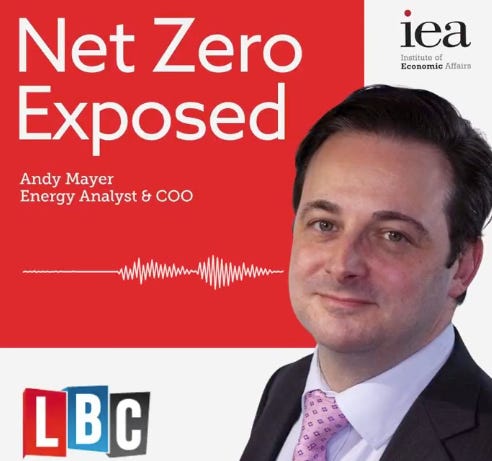
Treating energy companies like welfare providers, Andy Mayer speaks to LBC on why rising energy bills are a policy failure, LBC
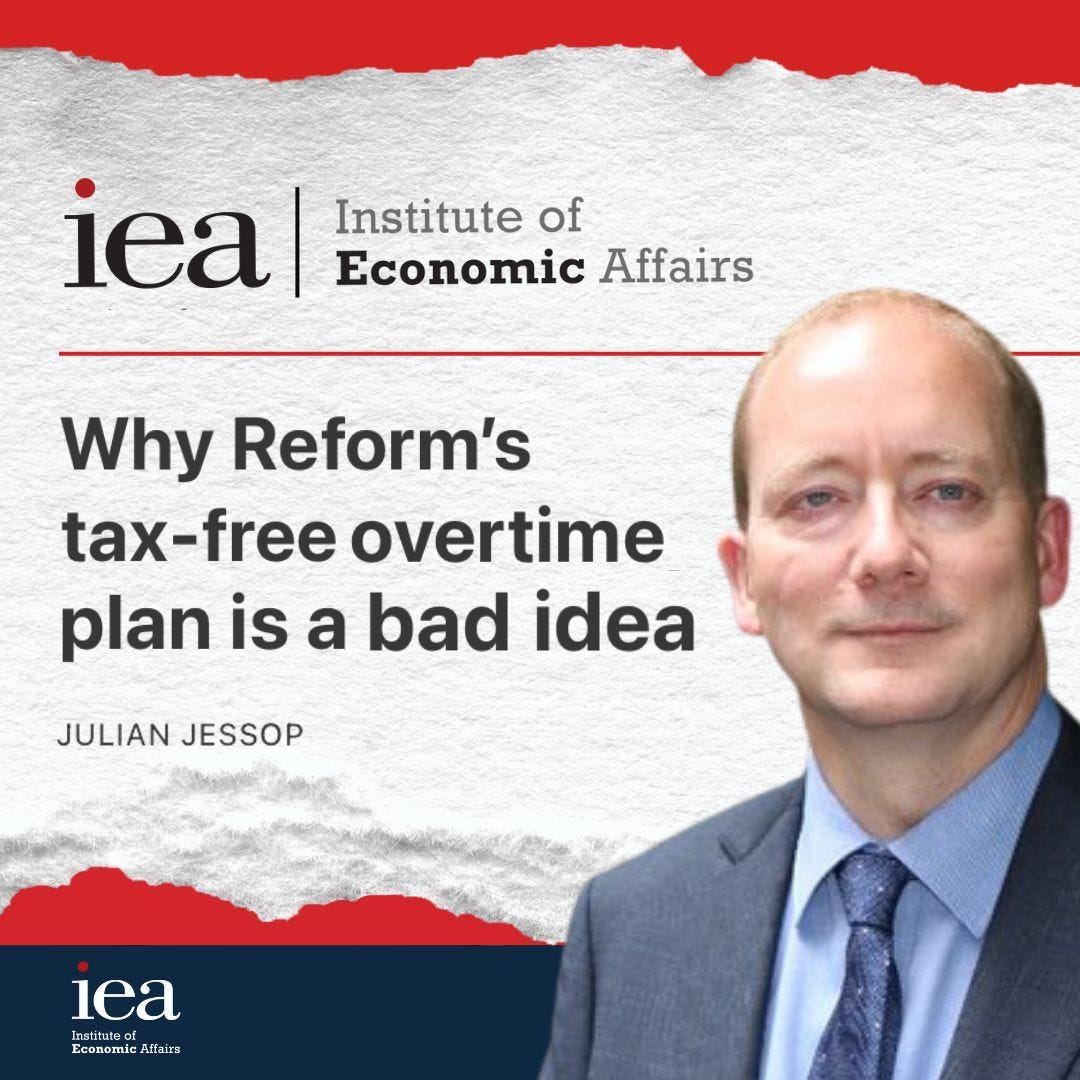
Julian Jessop on the surge in those young people not in education, employment or training:


Is British Politics Breaking Apart? George Maher discusses what actuarial science can tell us about elections with Daniel Freeman, IEA YouTube
What Gen Z needs most is economic growth, Michael Turner elucidates the findings of our recent polling on attitudes to economic growth, Spiked
“Freshwater Strategy and the Institute of Economic Affairs (IEA) recently released a report on British public attitudes towards growth that captures the mood. Younger voters are pessimistic to the point of cynicism, but they are certainly not anti-growth. Quite the opposite. They are desperate for it. They have just never experienced it.”
Andy Mayer speaks on energy price escalation on Talk TV

“This idea has many flaws — it would be unfair, complex, and have many unintended and unwelcome consequences”, Julian Jessop on why Reform’s tax-free overtime plan is bad economics, Substack
Are supermarkets really ripping us off on the price of milk? IEA research covered in the Sunday Times
“But the truth is that although most of us believe supermarket profit margins are about 50 per cent, according to a poll by the Institute of Economic Affairs, the actual margin is less than 4 per cent. Supermarket pricing is a modern miracle. In 2001, the typical household spent £80.90 a week on food, adjusted for inflation, according to the ONS. By 2024, the latest year available, that bill was £70.50”
This London council’s Nimbyism shows why the housing crisis can’t be solved, IEA research on housing covered in The Telegraph
“Britain has a much lower level of housing supply than comparable countries,” according to the Institute of Economic Affairs. Research carried out by the think tank using 2024 figures concluded that: “Catching up with the EU average in terms of the number of housing units per 100,000 inhabitants would require the construction of 3.4 million additional homes in England alone.”