Universal Basic Income?
Plus: why is the state so big?


In today’s newsletter:
Should we introduce Universal Basic Income?
Why is this infantilising Government is turning us all into wards of the state?
The super-rich want a wealth tax
“Britain’s investment minister [Jason Stockwood] has revealed there are talks within government about introducing a universal basic income (UBI)”, the Financial Times reported this week. Stockwood and his allies believe that the adoption of Artificial Intelligence is going to lead to mass unemployment, and that UBI is the best way to cushion that blow.
Both of these claims can be challenged.
First of all, it is worth restating the reason why technological progress does not generally lead to unemployment.
“Technology X leads to massive job losses in sector Y” sounds bad. “Technology X leads to massive efficiency improvements in sector Y” sounds great. But both statements describe the same thing.
As long as Y is a reasonably competitive industry, efficiency improvements will, in due course, be passed on to consumers in the form of lower prices. This means that consumers are now richer. They will now demand goods and services in some other sector, Z, that they could not previously afford (or only sporadically). Somebody has to provide these goods and services, and in this way, the same process that destroys jobs in sector Y also leads to the creation of new ones in sector Z. Employment shifts from Y to Z, but its overall level remains broadly the same, and everyone is richer.
This pattern is hard to spot in the short term, because it is rarely dramatic. But it is crystal clear in long-term time series. For example, YouGov recently published their Dining Out Report 2025 UK, which is part of a publication series in which they look at how dining habits differ between generations, as well as between Britain and other countries. Three generations ago, such a report would have made no sense whatsoever. In the 1950s, the ONS’s Family Expenditure Survey did not even have a category called ‘dining out’ yet – not because nobody was dining out, but because, as a proportion of the average household’s budget, it was not big enough to deserve a category of its own. Britain was simply not rich enough to sustain a hospitality industry big enough to attract the attention of statisticians. People still had to reserve the bulk of their budgets for necessities, with not enough left for nice-to-have things. You could say the same about the entire leisure and entertainment industry, broadly defined.
Some argue that this time is different, and that the AI revolution is not simply a repetition of the widespread adoption of computers in the 1980s, or of the internet in the 1990s. Maybe so, and that’s a good enough reason to do something, but not to introduce a policy with potentially much bigger downsides.
Which leads us to the second part of Stockwood’s argument: UBI.
The most common argument in favour of UBI, particularly on the Left, is that people do not need economic incentives to work. It is part of our nature that we want to accomplish things.
This is true. But it also misses the point. The UBI-critical argument is not that if we had a UBI, everyone would sit around doing nothing. Of course people would do something. But what a UBI would do is sever the link between our activities and market demand. We would see a huge increase in the number of people who would want to be novelists, musicians, artists, actors, or full-time political activists. People would write Substacks on wine, and things like that. (OK, bad example...)
That’s not ‘doing nothing’, but it would mean flooding sectors that are already saturated even now.
UBI is a ‘Left-coded’ idea, in the sense that most of its supporters are found on the political Left. But it is not an inherently left-wing idea. There are classical liberals who are sympathetic to it, and there are Marxists who are against it (for reasons I don’t have the wordcount to get into today).
Liberal sympathisers argue that if we had UBI, we could get rid of all the welfare bureaucracy, and especially, of means-testing, with all its anti-work incentives.
They have a point. I prefer a targeted, conditional safety net to a UBI, but I accept that that involves some bureaucracy and adverse incentives. Income transfers do not just target themselves: someone needs to do the targeting. A targeted system needs welfare bureaucrats, whose job it is to establish who is entitled to transfer payments, and to how much. Those bureaucrats need to collect and verify information about people’s income, assets, and family status. That’s not great, and I’m not exactly in love with that system.
However: we could also save administrative expenditure if we just gave every police department in the country identical budgets, regardless of differences in crime rates, types of crime, local wage levels etc. But that would surely make policing less efficient overall, even if it led to some administrative savings.
Similarly, a welfare system in which James Dyson, the Duke of Westminster, Alan Sugar, J.K. Rowling and Rishi Sunak are entitled to benefits does not strike me as ‘efficient’, even if it is unbureaucratic.
UBI is a dead end. We are better off trying to simplify the welfare system we have, and improve work incentives within it. The introduction of Universal Credit was already a step in that direction, and this agenda can be built upon.
Kristian Niemietz
Editorial Director
The best way to never miss out on IEA work, get access to exclusive content, and support our research and educational programmes is to become a paid IEA Insider.
IEA Podcast: Head of Media Reem Ibrahim is joined by Director General David Frost and Editorial Director Kristian Niemietz to discuss whether there is reason for optimism and Universal Basic Income —IEA YouTube
This infantilising Government is turning us all into wards of the state
by David Frost
If this Government and the Labour Party stand for any political philosophy at all – and that is pretty hard to discern at the moment – it is the belief that “the Government knows best”, that state authorities have better insight than you into how you should spend your money and live your own life.
This world view drives the relentless growth of government spending and state power which we see every day. All through British society, power is shifting from the individual to the collective, from the political to the bureaucratic, from the local to the distant. Police forces are to be regrouped. Local government is being reorganised to replace one two-tier system with another, more remote form. And everywhere people face constant tinkering and disempowering change that makes life more complicated for no good reason.
News and Views
The Nuclear Option: Rethinking Britain’s Path to Net Zero with Henry Hill | IEA Interview, Energy Analyst Andy Mayer sits down wih the Deputy Editor of ConservativeHome Henry Hill, IEA YouTube
‘Woke’ banknotes: Bank of England orders money printer to follow ESG rules, CityAM
A separate report by the Institute of Economics Affairs said diversity initiatives led by the Financial Conduct Authority (FCA) and other public bodies had gone “far beyond” remits set by legal requirements.
Callum Price, director of communications at the Institute of Economic Affairs said: “All government bodies, the Bank of England included, should only be concerned with doing the job that they have been created to do to the best of their ability. This means keeping costs down as much as possible and resisting mission creep.
“Tying unnecessary baubles onto the requirements for procured contracts that do not affect the primary role of the contract will only drive up costs, increase inefficiency, and reduce competition.”
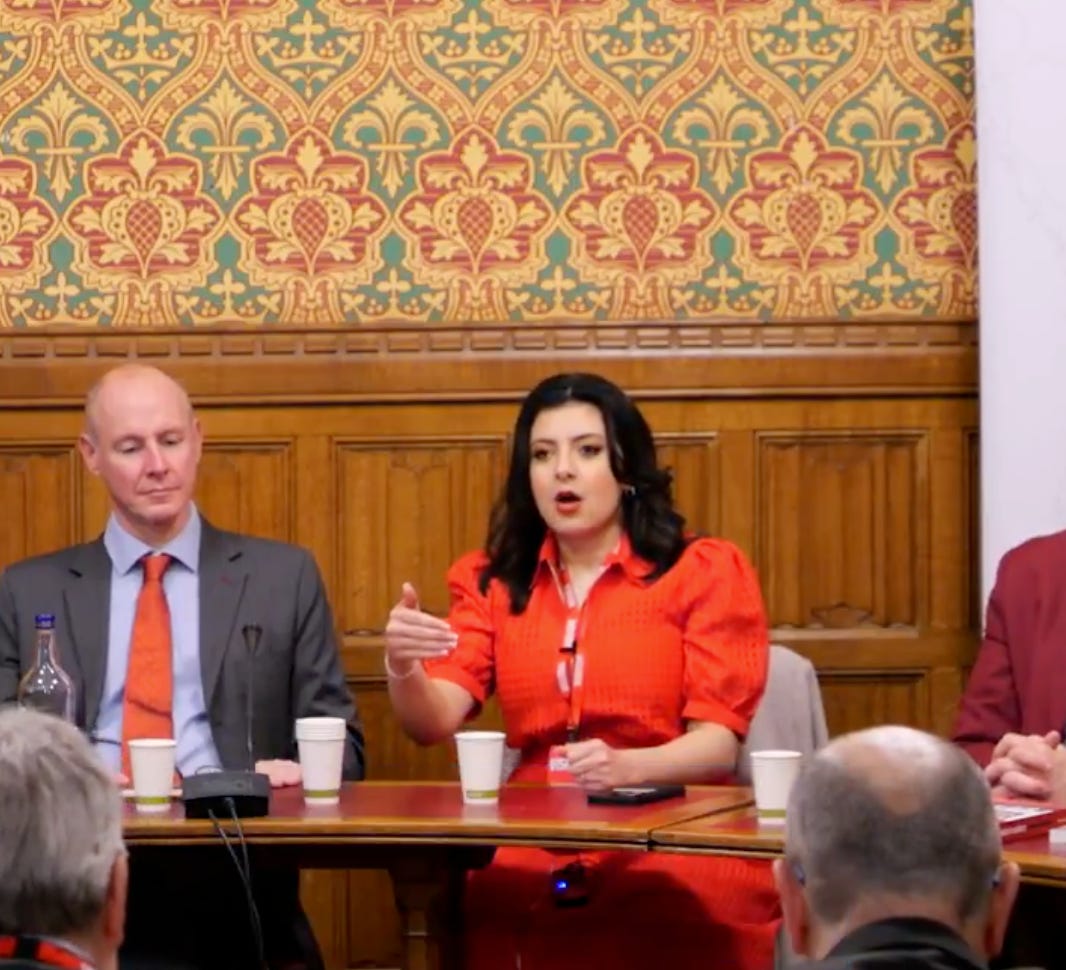
6 Years since Brexit, Head of Media Reem Ibrahim spoke at an event in the House of Lords, X
From £52k to £80k: John Cochrane on How Britain Can Catch Up With America | IEA Interview, fellow of the Hoover Institution John Cochrane, IEA YouTube
Head of Media Reem Ibrahim appeared on BBC Politics Live, BBC Two

Watch a clip on X here!
 | A guest post by
|
UBI is not really a single idea but rather an approach that can have various outcomes. We can't afford to pay UBI at a level that replaces most benefits. This suggestion is a distraction.
But I support a relatively low, monthly taxed payment to every person who has a legal right to reside in the UK (so that includes children and the elderly, etc.). Perhaps about a third of the state pension, paid reliably.
So a pensioner would receive it on top of other payments (but might lose some of the extra income in income tax).
A parent would receive it for both them and their children, on top of other benefits, making it more viable to decide to stay at home and care for them.
I would pay for this by lowering the threshold for 40% tax, reducing the level of universal credit, and ending zero-rate VAT.
Some middle-income workers might be a bit worse off, but my plan improves the circumstances of many destitute and elderly people, helps make work pay, reduces "targeting" of benefits, (which, in my opinion, undermines personal autonomy), and helps the working poor (especially if they have children) without undermining incentives for the well-paid.
A very interesting subject Kristian. On the one hand the government wants to pay those in need of financial help. And on the other hand they have to reduce the cost of this help to government. Because they are themselves underfunded with too little tax take.
And here lies the rub! No matter what they do the government can’t afford their choices. But more worrying they never will! They pretend that they have the model that can do what’s needed within the budget they award.
But the gap never closes! No matter what scheme they scheme up they can never make ends meet. They are trying to water down either the amount they pay or pay a fewer amount of people by deliberately excluding swathes of citizens who should be entitled to help all because the tax take us insufficient to do the right thing. We are all underfunded. But in this matter the government is underfunded. So instead of doing the right thing they, do the wrong thing and cut! Stating unaffordable ad the reason. Or let’s cut bureaucracy as a reason to pick a way to give to all, like a state pension.
You Kristian state good arguments why a UBI is not fair. Or why a targeted help us better. But what you are not looking at is how the system can raise its game. How can the government get more tax income? How can the economy grow to give the tax income we need to afford a really good fair and inclusive system? You don’t seem to see its money supply that causes an underfunding. Because it seems you assume all money is in play all of the time and clearly it’s not.
I’ve been replying to these blogs for a while now. And nowhere have you or anyone at the IEA responded lied to me, argued with me debated with me or looked at the framework to establish a better system?
If money is insufficient within the economy, not enough of our money is being SPENT in sufficient amounts in sufficient time then of course the economy will be slow!
If after decades of this underfunding the ‘contestants’ in this game are devoid of sufficient throughput to give the required tax take what do you think would be the result? Is it not exactly what we see now? A government do in debt and a pit of money that goes nowhere to do what we expect a government to do? Doesn’t it explain our present position of a lack of money? The rich getting rich and the poor getting poor? A few mega rich individuals who don’t have to spend money, who lend money and get rich off not spending? And a government looking at stupid schemes to cut costs?
Look the truth is that without a ready supply of money being freely spent no business can be done at the pace required. Unless you want a society of mega rich next to mega poor like the USA or Brazil it Venezuela or China or Russia then keep going.
But if we want a proper system, one that works, it’s easy! You have to make all money move, all of the time, rather than like now where insufficient money in a slow time is being SPENT.
The government are trying to squeeze the pops out if this failed monetary system. Trying to put more and more taxes on a declining system.
The rich are starting to say tax us! But it’s not a tax we need. It’s all that money being freely SPENT! We gave taxes already in place to suck up the tsunami of revenue that increased spending will attract. It’s called VAT and DUTY. But moreover it triggers more income tax snd nic as more people are employed to supply they need invigorated money supply.
That’s growth Kristian!
Schemes like UBI are just that. A scheme. We need a proper answer. Not a false move.
We are not skint! There is £19 trillion pounds out there. Apparently! If they were to be spent just once? In one whole year, the resultant vat should be £3.8 trillion pounds! Four times our present state of affairs from all taxation! So it’s obvious our money is NOT in the economic system!
That’s the problem do I ask you to start investigating this? Where is our money and why is it not in our pot?
Because if it was. There wouldn’t be a problem of underfunding. No, we’d be swimming in the stuff!