Turning negatives into positives
Plus: a dystopian satire and defending liberalism from its defenders


In today’s newsletter:
The UK economy: perceptions vs reality
The NHS is no longer the sacred cow it was
More fantasy economics
Britain is not much richer today than it was in 2007. An entire generation has grown up which has never really experienced economic growth, and all the benefits it brings. Stagnation and relative decline is all they have ever known.
This is extraordinary. By the standards of Britain's peacetime economic history, the current period is an anomaly.
And yet - while we at the IEA obsess endlessly about Britain's lack of growth, it often feels as if the country at large is not that bothered. The book stores are full of trendy "Degrowth" literature, and large sections of the media seem far more excited about the latest culture war episode than about economics. Are we barking up the wrong tree?
The short answer is no. Clearly not.
This week, the IEA published the report "A Growth Mindset? Public understanding of British economic performance and attitudes to pro-growth policies" by Matthew Lesh and Mike Turner. Based on both quantitative and qualiative research (polling and focus-group interviews), it demonstrates quite conclusively that economic concerns are very much at the forefront of people's minds, even if this is not always well-articulated.
The results reveal a strange, seemingly incoherent mix of negativity and complacency. On the one hand, the vast majority of respondents have a very bleak view of the state of the British economy. Yet at the same time, people tend to grossly overestimate how rich Britain is compared to other economies. In the aggregate, respondents think that if Britain became part of the USA, it would be the seventh-richest state. That's not even close to the truth: Britain would be the poorest state in the USA. Even more ludicrously, a third of respondents think Britain is richer than Switzerland, when the truth is that Britain is closer to Bulgaria than to Switzerland in terms of real income levels.
I would like to see less negativity of the fatalist, defeatist kind, because a directionless doom-and-gloom attitude is not going to lend itself to any improvements. But I don't believe in "positivity" either. I believe in constructive pessimism. I want more people to have a realistic idea of Britain's relative economic standing, because I think this would focus minds, and change policy priorities. As many economics commentators have pointed out before me, the British economy is one that gets a lot of the difficult things right, but then ruins it all by messing up the simple things. Britain's economic problems are largely self-inflicted, which means that they are also very much solvable with the requisite political will.
The report also shows that when people are told where the British economy really ranks internationally, the reaction is one of shock and anger. That's good. That's the right response. Our job as free-marketeers is to channel those negative emotions into productive avenues.
Kristian Niemietz
Editorial Director
The best way to never miss out on IEA work, get access to exclusive content, and support our research and educational programmes is to become a paid IEA Insider.
IEA Podcast: Director of Communications Callum Price is joined by Editorial Director Kristian Niemietz and Director General Lord Frost to discuss public opinion on the economy, NHS reform and price caps - IEA YouTube
Brits vastly overestimate their wealth
Landmark new public opinion research published by the Institute of Economic Affairs found Britons place the UK 7th among US states, on average, in terms of GDP per capita, believing it is richer than 43 of them. In reality, the UK ranks last, behind every single US state. When told this, 27% of respondents said they felt shocked, with a further 15% expressing disappointment or embarrassment. Focus group participants similarly responded with anger and frustration – “it suggests that there needs to be change in the UK because we can’t be fifty-first, there’s no way” said one focus group participant
The research found that the British public overwhelmingly supports economic growth. Eighty-seven per cent say the country should focus more on growth, with just 9% saying the country is already wealthy enough. This consensus holds across all age groups, income levels, regions, and political affiliations – demonstrating a lack of appetite for “degrowth” narratives among the public.
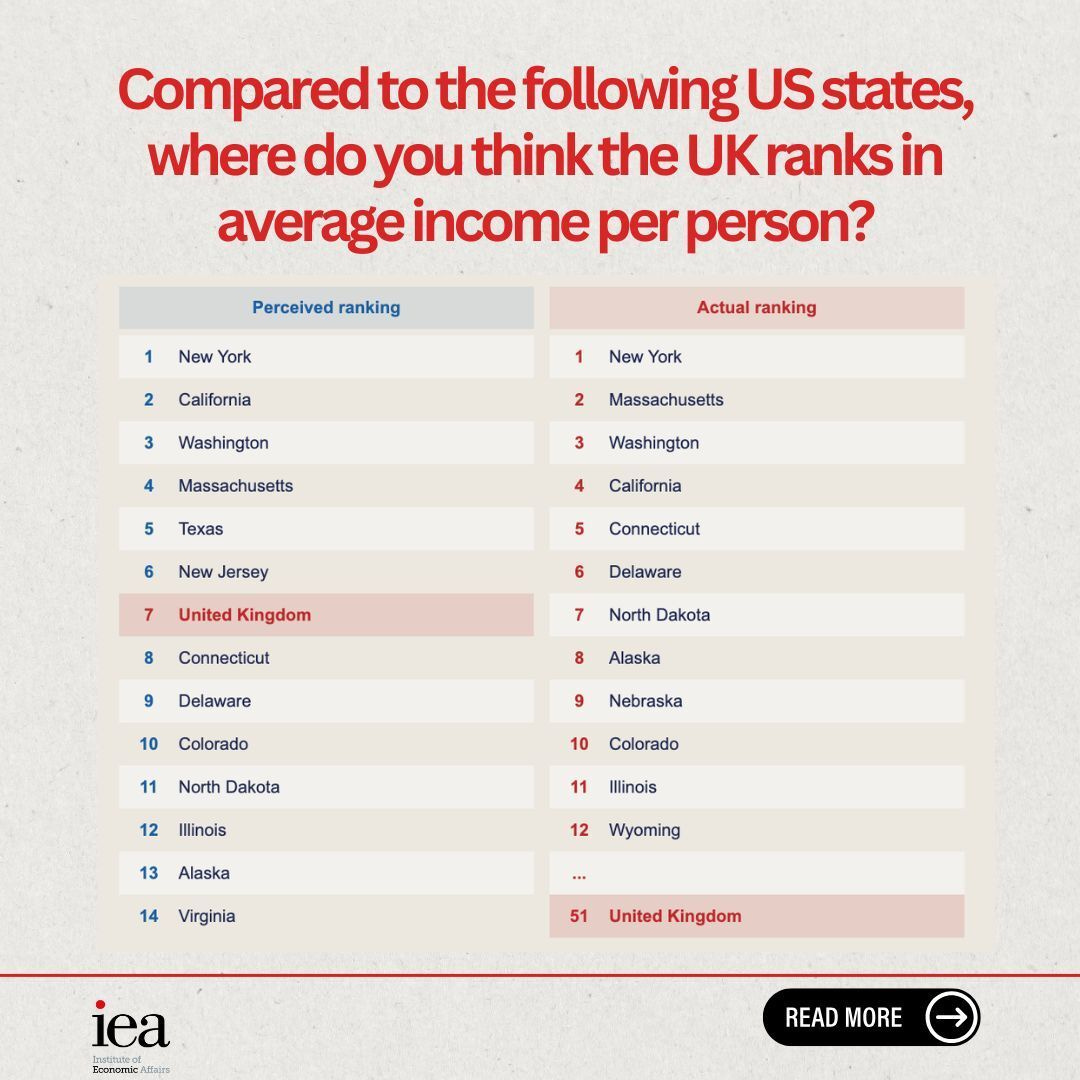
“We would be 51st. We would be poorer than Mississippi. That’s an astonishing statistic”, the report findings discussed on GB News
Our national decline is even worse than the British public thinks, David Frost writes in The Telegraph
“Most Brits think we’re as rich as the Americans. We’re probably 40% poorer.”, David Frost discusses the report on TalkTV
Britain is far poorer than people think, Callum Price lays out the research in CityAM
Britain is poorer than we think, Matthew Lesh explores the findings in CapX
News and Views
“The NHS is no longer the Sacred Cow it once was”, Kristian Niemietz on why the NHS debate has finally grown up — and why the case for Social Health Insurance is stronger than its critics admit, The Critic


Defending liberalism from its defenders, Chris Snowdon mounts a robust defence of liberalism from the efforts of its other advocates, The Critic
“The early neoliberals used economic logic to explain why Bolshevism would fail. After 1945, they spent years in the wilderness warning that Keynesianism would also fail. They were right both times. Their teachings helped to control inflation for decades until governments unlearned the lessons during the pandemic. Their arguments against tariffs, protectionism, rent controls, nationalisation and over-regulation are timeless even if they need to be re-learnt every few generations.”
“I think people are thoroughly fed up with the way the country has been run.”, David Frost on voter attitudes towards Brexit, BBC Politics Live

Critics hit out at plans to ban phones in schools, Andy Mayer quote in The Express
Andy Mayer from the Institute of Economic Affairs saying: "Schools should be free to set their own controls on technology use in line with the needs of the pupils and wishes of the parents. Parents can then choose schools whose policies align with their child’s needs.
Net Zero’s dirty secret, Andy Mayer interviews Catherine McBride on Free the Power, IEA YouTube
Space is the new frontier in economics, Kristian Niemietz reviews Rainer Zitelmann’s case for space capitalism, CityAM

Scrap ‘indefensible’ pensions ‘triple lock’, IEA quoted in the Daily Mail
The Institute of Economic Affairs has previously branded the lock ‘one of the most expensive commitments in British public policy’ and ‘an electoral bribe with a compound interest rate’.
Events and Opportunities
Opportunity: Want to help shape the big decisions of our time?
The Public Policy Bootcamp (3-5 June, University of Buckingham) is a 2.5-day residential deep dive into today’s key challenges (from global trade to fiscal policy) hosted by the IEA and the Vinson Centre. Open to early-career professionals across politics & research.