

No wonder we have a productivity crisis
Plus: price caps and floors and big tech bashing


In today’s newsletter:
The moral case for capitalism
Britain isn’t broken, but the government is
Have real wealth taxes never been tried?
‘Rockstar economist’ Thomas Piketty has assembled a top team of 45 contributors from prestigious institutions, plus research assistants and a press and media team etc, for his ‘Global Justice Project’ and his ‘World Inequality Lab’. And yet, with all those resources at their disposal, the best they could come up with is some 2014-era Russell-Brand-style slop mixed with 2019-era Greta-Thunberg-style slop.
My issue with the Piketty project is not the fact that the authors are wrong about everything. It is the fact that they are wrong in the complacent way of someone who isn’t even trying, because they know that they don’t need to.
I could easily spend the next 12 months doing nothing else but debunking this project’s fashionable fallacies, but I’ve been given a word limit, so I’ll just briefly touch upon three things.
Firstly, Piketty et al claim that “the promise that economic growth would “lift all boats” has not been kept. […] Growth has become decoupled from shared prosperity.” It hasn’t. Not even close. While their claim that “roughly one 10th of the world’s population still lives in extreme destitution” is correct, they fail to mention that that is the lowest this share has ever been, down from 43% in 1990. Obviously, if you use a higher poverty threshold, you get higher poverty rates, but wherever you want to set the threshold, the trend is always downwards. I’d rather keep that trend going.
Regarding the idea that we have to forcibly stop economic growth because of climate change: that’s exactly the wrong thing to do. Despite climate change, the number of climate-related deaths (and deaths from natural disasters in general) has dropped drastically over the past hundred years, even in absolute terms, despite the fact that the world’s population has grown so much. Since the world is so much richer than it used to be, we have become much more resilient to all kinds of adverse events. Most so-called “climate risks” are really poverty risks. Simply put: you will not usually read about climate disasters in Liechtenstein, even though their geography makes them vulnerable to snow avalanches, landslides, rockfall, flooding etc. That’s because they are so rich, they can deal with most things nature throws at them. Being rich is viable disaster strategy.
Regarding “the historical reality that many rich countries built their wealth by impoverishing the south” – that’s not a “historical reality” at all, it’s a fashionable slogan that has been debunked at length. It matters, because the way we see the origins of economic development shapes the conclusions we draw about economic development today.
I could go on, and probably will soon enough, but I don’t want to ruin your Sunday with Guardian slop. For now, let’s remember that the world is getting richer, that poverty is falling, and that all kinds of social and even environmental outcomes are improving. A lot of things are moving in the right direction, and will continue to, unless we let the Pikettys of this world ruin it.
Kristian Niemietz
Editorial Director
The best way to never miss out on IEA work, get access to exclusive content, and support our research and educational programmes is to become a paid IEA Insider.
IEA Podcast: Director of Communications Callum Price is joined by Director General Lord Hannan and Editorial Director Kristian Niemietz to discuss the latest de-growth push, government' concierge services, and price floors, IEA YouTube
New Book: On Morality, Human Behaviour and Economics
On Morality, Human Behaviour and Economics is the first volume in a new series jointly produced by the Institute of Economic Affairs and the Vinson Centre at the University of Buckingham
The book argues that the case for free markets has been ceded by default – left undefended by business, dismissed by sections of the church and political establishment, and replaced with intellectually weak critiques
Contributors include Lord Kamall, Lord Elliott of Mickle Fell, Martin Vander Weyer, and the late Revd Dr Richard Turnbull, whose chapter is published posthumously
Read more in CityAM’s editorial: Never forget the undeniable moral case for capitalism
News and Views
Director General Lord Hannan breaks down the folly of price caps and price floors

Ten years after Brexit, Economics Fellow Julian Jessop discusses the economic consequences of Brexit ten years on, BBC Radio 4
Government tech image ban will inevitably be exploited by bad actors
Responding to the Government’s plan to regulate images on devices, Matthew Lesh, Public Policy Fellow at the Institute of Economic Affairs said:
"The Government's plan to turn every smartphone into a government scanning device is a creepy infringement on user privacy that will inevitably be exploited by bad actors with nefarious intent – be it criminal hackers or authoritarian governments.
"Over 90% of contact child sexual abuse is committed by people known to the child, according to the NSPCC. No phone-level fix addresses that. The unglamorous task of safeguarding children does not come with easy technical fixes.”
Keir Starmer forces tech firms to block nude images for children, covered in The Times
"This amounts to surveillance technology on every device in the country." Matthew Lesh on the government's proposed device controls in CityAM.

The LSE has a lot to answer for, Editorial and Research Fellow Professor Len Shackleton writes on how the institutions that have incubated so many of our political leaders have lost sight of some of the basic principles of economics, CapX
“The historical experience with wealth taxation, by and large, is a failure. Pretty big failure.” That’s not a Tufton Street economist. That’s Gabriel Zucman, the guru of wealth taxation, on Zack Polanski's own podcast. Kristian Niemietz asks why they still want to bring it back, in CityAM
Proposals to repeal the Public Sector Equality Duty welcomed
Responding to the Conservative’s pledge to scrap the Public Sector Equality Duty, Daniel Freeman, Managing Editor said:
“Proposals to scrap the Public Sector Equality Duty are welcome. It would reduce bureaucratic box ticking by public sector officials and reduce public bodies’ exposure to drawn out court cases, like the one that prevented a former pub converting to new homes on the grounds the council had failed to consider the duty in the Equality Act.
“However, it does not address other areas of concern such as Section 159 of the Equality Act’s ‘positive action’ provisions, which can allow irrelevant identity criteria like race, sex or sexuality to play a role in recruiting. Politicians should be tackling knotty and sensitive issues from a rational liberal position like this, but those who really want to prioritise meritocracy should consider removing positive action from public sector recruitment along with the Equality Duty.”
“If we want to have a reasonably high threshold for incitement, we have to apply it across the board.” Lord Hannan on why free speech must be consistent, GB News
Julian Jessop responds to the latest growth figures:

“Britain is not broken; the government is.” Mani Basharzad in ConservativeHome on why conflating state and society is a profound conservative mistake.
Events and Opportunities
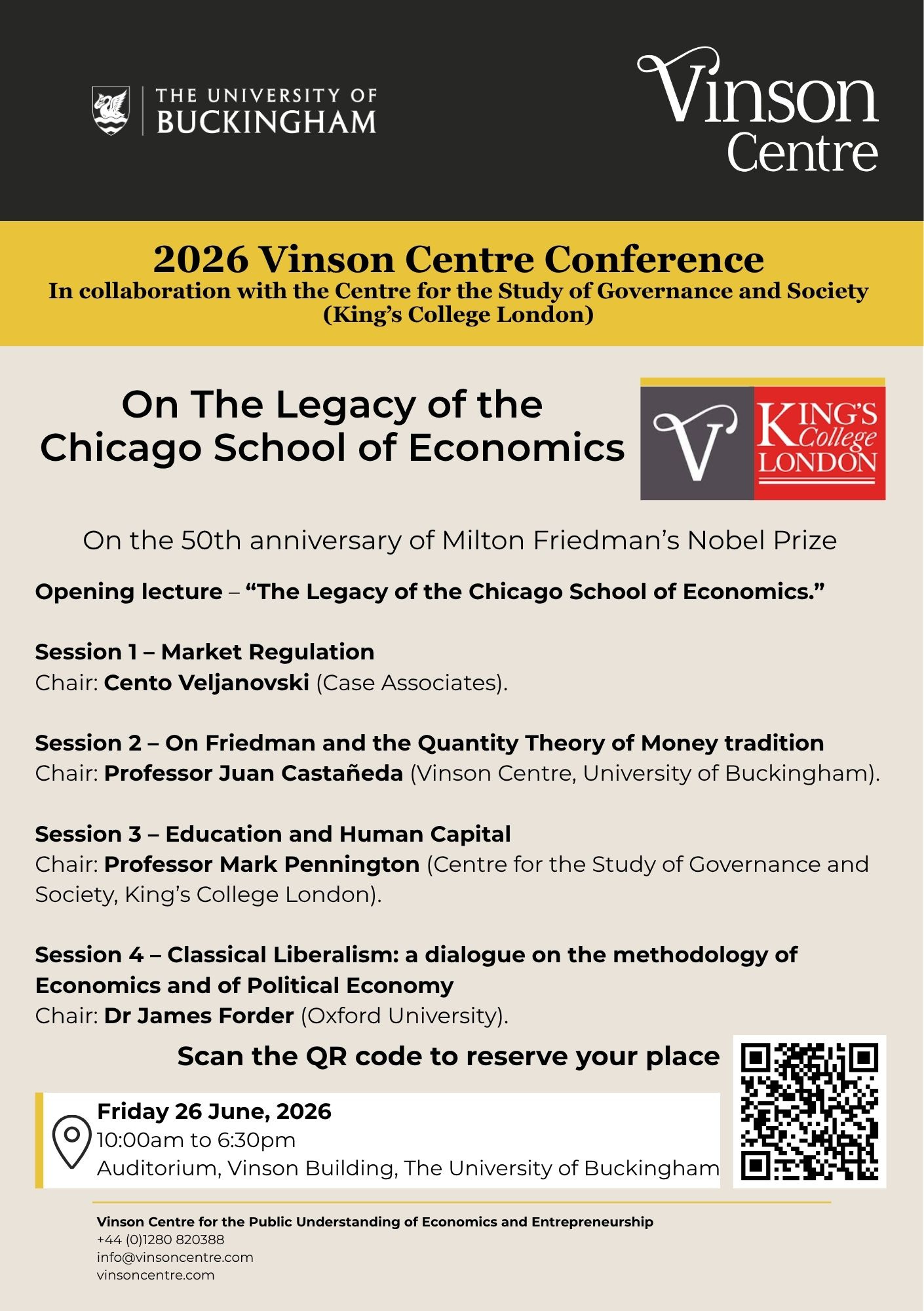
The 2026 Vinson Centre Conference
Margaret Thatcher Centre’s Annual Academic Symposium
Under the chairmanship of the Academic Director of the Margaret Thatcher Centre, Dr Tim Aker, and building on the tremendous success of our inaugural event, the Margaret Thatcher Centre is proud to continue its annual academic symposium, with the second event of the series taking place on Friday, 10 July 2026, at Churchill College, Cambridge.
This year’s symposium will continue our deep dive into the Iron Lady’s enduring legacy and will further examine the geopolitical and economic shifts of her era in the context of the passage of the Single European Act in 1986.
You will hear from eminent speakers who will explore these issues with an engaged audience of some 100 academics, students, politicians, journalists and supporters. The list of speakers includes:
The Revd Jonathan Aitken, British author, Church of England priest and former Conservative Party politician
Peter Just, Author, Margaret Thatcher: Life After Downing Street
Professor The Lord Norton of Louth, Professor of Government, and Director of the Centre for Legislative Studies, University of Hull.
The Rt Hon Sir Malcolm Rifkind KCMG KC, Former Secretary of State
Dr. Lee Rotherham, Research Fellow, Taxpayers’ Alliance
Lee Evans, John Ramsden Fellow, Mile End Institute, Queen Mary, University of London
Sir Gerald Howarth, Former Private Secretary to The Rt. Hon Baroness Thatcher of Kesteven
Professor Anthony Teasdale, Visiting Professor, LSE and Columbia University; Former Director General, EPRS, European Parliament
Michael McManus, The Telegraph
Complimentary student tickets available.
 | A guest post by
|