

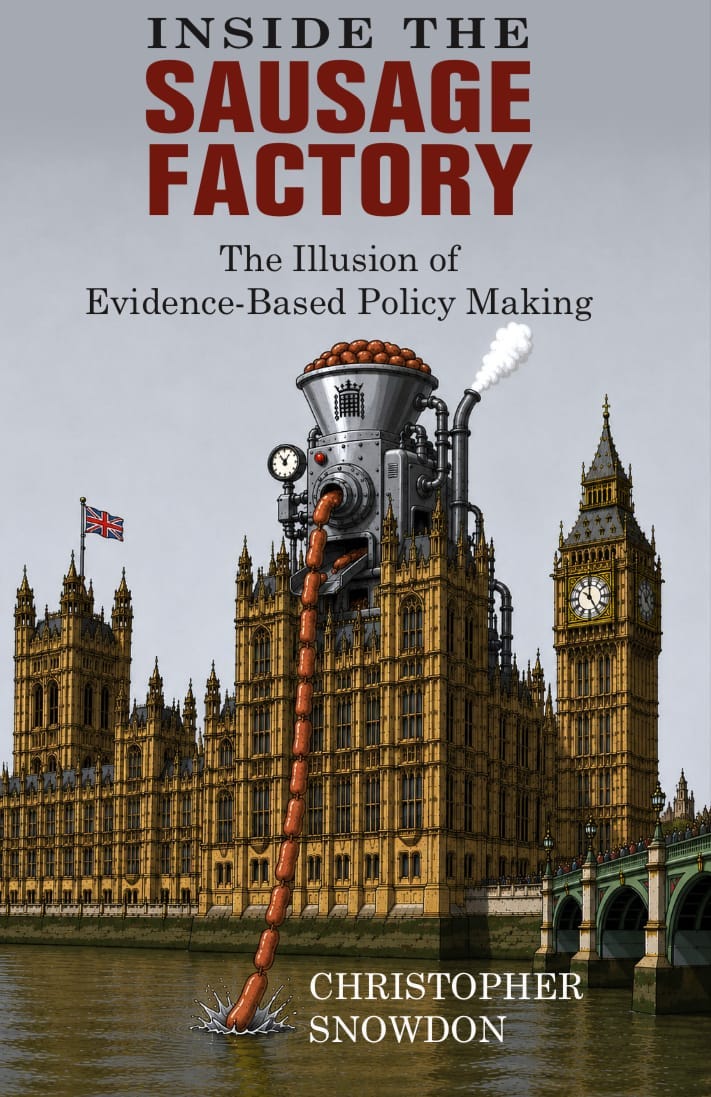
Is the policy-making in the UK evidence based? That is the question I address in my new book, Inside the Sausage Factory. I took four public health policies from the 2010s and examined all the evidence that was cited for and against them in the media and in Parliament. You would hope that policies pertaining to the health of the public would be more evidence-based than most, but that is not necessarily so. Campaigners for each of the policies - plain packaging for tobacco, minimum pricing for alcohol, the sugary drinks tax and the de facto prohibition of fixed-odds betting terminals - had plenty of peer-reviewed studies and expert reviews to wave around, but the evidence suffered from serious flaws and when the policies were eventually introduced, there was little sign that they made the slightest improvement to any of the problems they were supposed to address.
Close examination of each of the policy campaigns suggests that politicians did not make decisions based solely, or even mostly, on the basis of evidence. Instead, the government of the day responded to political pressure whipped up by campaigners on issues that were not a priority for them. Most of the policies had not existed even as ideas until a few years earlier. None of them had appeared in the manifestos of any of the main parties, with the exception of minimum pricing which was mentioned by the Liberal Democrats in 2010 - and yet minimum pricing that was the only one of the four that was never introduced in England.
A handful of MPs felt strongly about some of these policies but they were low salience issues for the government. It was lobby groups such as Action on Sugar and the Campaign for Fairer Gambling who pushed them up the agenda, issued press releases, got celebrity endorsements and garnered media coverage. This all had an effect on public opinion and forced the government to make a decision. Since the politicians are rational actors who want to get re-elected, they gauged public opinion and asked themselves whether the political costs of doing nothing were greater than the political costs of acting. By the time the decisions were made, only 15% of the public were opposed to plain packaging and only 6% of the public were opposed to clamping down on fixed-odds betting terminals. Resistance to the sugar tax was more substantial, at 33%, but opponents were clearly in the minority and George Osborne needed to make an announcement at the Budget that would take the nation’s mind off the cuts he was making to disability benefits.
Public opinion was evenly split on minimum pricing, however, and it is telling that this was the only one of the four policies that was not introduced in Westminster. In Scotland, by contrast, only a third of the public were opposed and the SNP had nationalistic reasons to forge a different path and become a ‘world leader’ in public health.
It would be an exaggeration to call this government by opinion poll, but that would be a more accurate description than ‘evidence-based policy-making’. Evidence did serve a purpose. Modelling studies showed how the policy could work in theory. Evidence from other countries where similar policies were in place reassured politicians that the they were at least enforceable and would probably not create a public backlash. The regular publication of new research gave the pressure groups a way of keeping their campaign in the news.
But scientific evidence was only one part of the overall campaign and was never decisive. In the plain packaging campaign, there were far more references in the media to Lynton Crosby, a government advisor, and his alleged links to the tobacco industry than there was to all the peer-reviewed evidence on plain packaging combined. Similarly, Jamie Oliver’s support for the sugar tax was mentioned in more articles than all the evidence for the policy combined. It was the general climate of opinion, not the careful scrutiny of academic research, that mattered.
The four case studies in Inside the Sausage Factory suggest that politicians will succumb to pressure on low-salience issues unless they believe that the policy will be widely unpopular or conspicuously backfire. Once the public health interest groups had put their policies on the agenda, the government could not put off a decision forever. They became ‘barnacles on the boat’ that needed to be scraped off, either by implementing them or by rejecting them. With the exception of minimum pricing in England, which had significant public and political opposition, the government in Westminster concluded that the reputational risks of inaction were greater than the political, economic and legal risks of acting. This can be inferred from the results of opinion polls, the tone of media coverage and the fact that the policies had already been tolerated, if not embraced, by people in other countries. By and large, this judgement has been vindicated. Although the evidence that any of the policies achieved their objective is virtually non-existent, there has been no significant political blowback from introducing them.
Consistent with public choice theory, I find that everyone involved in these policy campaigns, from the voters up to the Prime Minister, was acting in their own rational self-interest. Most of the politicians didn’t care about the price of sugary drinks or what people get up to in betting shops, but they did want to get re-elected and they didn’t want to be on the wrong side of history. So long as they were confident that the policy wouldn’t backfire spectacularly, lose the government a lot of tax revenue or be very unpopular, siding with the nanny state was the path of least resistance. The decisions to introduce plain packaging and effectively ban FOBTs were particularly easy because only a small minority smoked, an even smaller minority played machines in bookmakers and there was limited public opposition.
The people who told pollsters that they supported these policies were acting in their own self-interest too. For those who didn’t consume the products in question, the rational response was either apathy or mild support for the nanny state cause. The sugar tax effectively transferred money from those who consumed sugary drinks to those who did not. A reduction in smoking and heavy drinking was widely assumed to cut NHS costs, thereby lowering taxes or providing better treatment to those who do not drink heavily or smoke. Cutting the stake on FOBTs was assumed to reduce the number of high street betting shops, thereby freeing up commercial property for shops that might be of more benefit to non-gamblers and, in the opinion of many, lifting the character of the high street.
Whether or not these assumptions were realistic is beside the point. The vast majority of the public were not actively involved in campaigning for or against any of the policies and their ‘support’ amounted to no more than expressing an opinion in a survey. The putative benefits of the policies to individuals who did not consume the products may have been negligible, but the cost of agreeing with the policies was zero (and since all the campaigns involved alleged social evils, social desirability bias encouraged support). Like the politicians, the public did not need to be convinced that the policy would work so long as they had no reason to believe that they would be adversely affected if the policy failed. So long as there was some chance that they would benefit, however indirectly, from fewer people using a product that they themselves did not consume, they could be persuaded that the policy was in their interest.
As for those who did consume the products, they mostly did nothing to defend themselves, but the was rational too. As Mancur Olson explained in The Logic of Collective Action, individuals know that their participation in an organised protest group will make virtually no difference to the outcome. The cost of taking action is typically greater than the cost that the policy will impose on them and so they do nothing. In my case studies, some consumers were prepared to voice their opposition in low-cost ways (more than 100,000 people signed a petition against plain packaging, for example), but they otherwise had little option but to free ride on whatever campaign the affected industry could muster up (the industry was also acting in its own self-interest, as the “public health” groups never failed to point out). As a result, there was no grassroots opposition to the nanny state campaigns.
But there was no grassroots activism for the campaigns either. All of the single-issue pressure groups were small, highly professional lobbying outfits funded either by the government or by a wealthy benefactor. It was completely rational for them to campaign for changes to the law because it was their job. Similarly, it was perfectly rational for activist-academics funded by the state to produce impactful, partisan research in high profile journals. The UK’s Research Excellence Framework (REF) defines impact as “the effect on, change or benefit to the economy, society, culture, public policy or services, health, the environment or quality of life, beyond academia.” Such a system positively encourages academics to engage in high profile, winnable policy campaigns in fields such as “public health” which are awash with money. Academics from Oxford University later filed a case study with the REF taking credit for ‘Creating a favourable policy environment for new sugary drinks taxes’ while academics from Cambridge University boasted about ‘Making the case for the sugar levy’ and ‘Fuelling sustained government action on sugary drinks’.
Everyone was acting in their rational self-interest and yet it led to a succession of policy duds. In politics, everyone acting rationally can lead to irrational policies being introduced. None of the policy decisions I studied were evidence-based. At best, they were evidence-decorated.
What happened next? There was more of the same from the same pressure groups, but with even less evidence. Action on Smoking and Health moved on to lobbying for a generational tobacco sales ban. Alcohol Focus Scotland shifted its attention to an alcohol advertising ban. Action on Sugar called for the sugar tax to be extended to food and milkshakes. The anti-smoking, anti-alcohol, anti-obesity and anti-gambling groups all called for a levy on the industries they saw themselves as being at war with.
The Obesity Health Alliance campaigned for a ban on ‘unhealthy food’ advertising and was the first to chalk up a win. In July 2020, a slew of anti-obesity laws was suddenly announced, including an online and pre-watershed television advertising ban, a ban on volume price discounts and restrictions on where HFSS (high in fat, sugar and salt) food can be placed in supermarkets. A familiar coalition of activists had been lobbying for these policies for years but since most of the policies had never been introduced in any other country, there was no ‘real world’ evidence to cite, and there were few relevant experimental studies in the academic literature.
When Boris Johnson became Prime Minister, they were assumed to be incompatible with his more libertarian instincts and yet they became part of a new obesity strategy a year after he took office. Evidence played no part in this. Two related events provide a better explanation. Firstly, Johnson was hospitalised with COVID-19 three months earlier and explicitly blamed this on him being ‘too fat’. Johnson’s hospitalisation became a focusing event which made the issue more salient for the nation and for the Prime Minister personally. Secondly, the UK had one of the world’s highest cumulative death rates from COVID-19 in July 2020 and obesity was a known risk factor for COVID-19 mortality. New anti-obesity policies were unlikely to have an impact before the pandemic subsided, but the new strategy signalled that the government was taking action and it helped shift attention away from its own policy failures in controlling the virus.
In October 2023, Rishi Sunak announced a permanent ban on the sale of tobacco products to anyone born after 2008, thereby introducing incremental prohibition. There was no ‘real world’ evidence to support this as it was untested, but it polled well, particularly with those who had voted Conservative in 2019. A survey conducted days before the announcement found that it was supported by over 70% of the public, with fewer than a quarter opposed.
The obvious risk of prohibition was that it would create a large and violent black market, but the government dismissed this as an industry scare story. As the legislation crawled through Parliament over the next two years, convenience stores in Australia started going up in flames and tobacco duty revenue fell by 75% as the country entered a ‘tobacco turf war’ driven by extremely high cigarette taxes and the prohibition of vapes. The British government paid no attention to this. The policy still polled well.
In December 2025, the Australian government tried to ban children aged under 16 from accessing social media. It didn’t work. Months later, 70% of kids still accessed at least one banned website and several children’s charities warned that a similar ban in the UK would lead to ‘serious unintended consequences that could put children at greater risk’. On 15 June 2026, Keir Starmer announced that he would be banning children aged under 16 from social media. Polls showed that over 70% of the public were in favour.
Only the most ardent advocates of these policy decisions were driven by evidence. In 2020, Boris Johnson was in a tight spot politically and, like George Osborne in 2016, found obesity to be a useful distraction. In 2023, Rishi Sunak was staring down the barrel of crushing general election defeat and clearly wanted a policy to be remembered by. Keir Starmer announced the social media ban in the week of the Makerfield by-election which could be the beginning of the end for his time in Downing Street. He, too, is looking for a legacy.
In the campaigns I write about in Inside the Sausage Factory, several studies were referenced again and again by politicians, journalists and activists. The policies didn’t work and the evidence wasn’t very good, but at least evidence was cited from time to time. The evidence for banning ‘junk food’ adverts and social media for the under-16s is negligible and the evidence from the generational tobacco ban is non-existent. Scientific evidence was not a decisive factor in any of the campaigns I studied from the 2010s. Today, it seems to be entirely optional.
The patterns identified in this book may not apply to policymaking in general, but they may be generalisable to a sub-set of policy-making that could be described as paternalistic lifestyle regulation. There is no reason, in principle, why they should not apply to any committed group of activists that has the opportunity and resources to apply pressure on government. For those who are of a liberal disposition, this is not a happy conclusion to reach. It implies that politicians can be hostages to small pressure groups manipulating public opinion almost without end. It suggests that minorities can expect to suffer at the hands of the majority if most people have no self-interested reason to defend the activities in question.
It is always possible that more far-sighted voters will become concerned that if they allow a succession of special interest groups to restrict or ban the pleasures of other people, it will not be long before their own pleasures are under attack. Since individuals are sometimes in the majority and sometimes in the minority, it may be in the long-term interest of the majority to defend minorities on principle. This is why defenders of free speech defend the right of people to say things that they personally find objectionable. Fearing that a precedent is being set, an individual may feel that the surest way to avoid a ban on X is to prevent a ban on Y, despite disapproving of Y themselves. In Britain, alas, there is little to suggest that the majority is prepared to take a principled stand against illiberal policies. Even those who are directly affected by coercive paternalism lack the time and resources to stand up against pressure groups that are often funded by the state.
And in case you’re wondering about the title of the book, it is a reference to a comment reputedly made by Otto Von Bismarck who said that laws are like sausages insofar as you don’t want to see how they are made. He had a point.
 | A guest post by
|