



When I was 17 years old I became a believer. I thought only in terms of theodicy, apologia, and proselytisation. I am talking not about Christianity of course, or any religion, but about libertarianism.
I am a natural fanatic. My mind always tells me that if something is true, it must be true to its maximum logical extent. I can sometimes hold in my head the idea that there are golden means: empirical cases where it happens that some arbitrary point upon a line is the optimal value. But my heart tells me that this sort of thing is crazy madness. If there are property rights, they must be absolute property rights or the argument for them must not be valid at all.
There are no records of exactly how I slipped into radical, hardcore libertarianism, but my hazy memories tell me that the Mises.org website was to blame. With a bit of work digging through their old forums, one could find my old profile, and all my doctrinaire arguments.
I took to libertarianism like a fish to water. It filled a hole that had always been missing in my life: the complete answer to all questions. People who knew me from that time could no doubt relate my diatribes against intellectual property (for being inconsistent with other property rights), the police, governments in general, and taxation, and my generally disagreeable, debate-happy demeanour. I read Robert Nozick’s Anarchy State and Utopia at university, and loved it, but by that point I was, if anything, critical of the book because it did not advocate the end of all governments.
I had a lot of what I would now call crony beliefs: views I believed in because they were necessary to support my deeper commitments. It caused me great consternation – even annoyance and anger – to be presented with situations like ‘is it OK to break into a hut to avoid dying in a blizzard’, presumably because of the underlying cognitive dissonance.
Over time, I came to identify as a ‘bleeding-heart libertarian’, after the blog of the same name, which I read a lot of in the early 2010s. (A quick Google informs me that it closed down in 2020.) If you asked me, I would tell you that I no longer believed in the ‘natural rights’ account of libertarianism – instead, I would say that I believed in utilitarianism or consequentialism, which just happened to be consistent with libertarianism.
This was a lie and in my heart I was still a committed libertarian. I knew in my heart it was completely true in every respect, as you could easily tell by seeing my irritation and instinctive need to argue every point that I perceived to be a threat to the status of libertarianism as an idea.
Darwin versus Friedman
Over time I developed. But as with many intellectual developments, there was no ‘aha’ moment or Damascene conversion. Instead, I continued to think of myself in the same way until I suddenly realised that I no longer believed in libertarianism any more. I remained a think tanker who advocated for neoliberal or libertarian policy solutions, but I was easily able to hold thoughts like ‘it may be optimal to limit property rights here’, or ‘this government scientific project did pretty well’ in my head without distress or cognitive dissonance. My fanatical obsessions had moved elsewhere.
Freed from the need to find apologia for libertarianism, or proselytise, I substituted having one big model of everything that answers every question with a panoply of smaller models. After this point, I have never identified as subscribing to any sort of ideology, but people usually call me a neoliberal. Occasionally I think that maybe I am a sort of conservative.
The best speech I can think of, by anyone, is Paul Krugman’s What Economists Can Learn From Evolutionary Theorists, which explains that evolution is modelled very similarly to the supposedly unrealistic ‘homo economicus’ type models that economists use. Evolutionary dynamics tend to produce maximising outcomes (or to go in that direction). This is part of an intellectual movement that is very important to me. The traditional approach is to see the market as mainly being about either incentives – the fact that you get more stuff if you do what society wants – or information – the fact that scarce things and high-demand things go up in price, showing that society wants them. Prices are indeed information signals ‘wrapped in incentives’. But I think that the best way to see the market is in terms of evolutionary dynamics.
Ronald Coase explains in The Nature of the Firm that capitalists and companies are a bit like central planners. A division leader in a company doesn’t bid for the time of employees against other division leaders. Companies rarely have internal markets or internal prices at all, meaning that most economic activity is not regulated by markets or prices, but command and control economies, where companies buy lumps of labour by the week, month, or year, and make theory-based decisions about how to deploy it.
So markets and prices, and the incentives and information they give us, can’t really be what’s important about capitalism. Instead, the importance of capitalism is that successful central planners (like Jeff Bezos and Elon Musk) get more and more capital to plan, making the economy more and more well planned. Unsuccessful ones get given less and less of the economy to plan. Capitalism is good because of evolutionary dynamics, with entrepreneurs and business owners following rules of thumb and theories about the world, often with very long feedback loops.
This evolutionary view also affects how I think about efficiency (I gather this is the view of Israel Kirzner and Joseph Schumpeter as well, but I haven’t read them!). Many people worry a lot about allocative efficiency in the current timeslice: making sure the right people are using each bit of capital, and the people who enjoy each good or asset most are getting to do so. Allocative efficiency is hugely important. But in my view, dynamic efficiency is much more important. Growth, which is the most important feature of civilisation, is driven by innovation and capital accumulation, not by sweating all of our existing assets more efficiently. I recommend reading The Quincunx by Charles Palliser, which is a novel, if you want a reminder of the crushing, grinding life that nearly everyone experienced before modern economic growth1.
Though the industrial revolution meant rapid overall economic growth, it led to barely any increase in living standards in Britain until after 1850, when fertility began to decline. I reject the popular view that Malthusianism was conquered by the industrial revolution alone: my view is that it was partly down to fertility control. Sufficiently many people can always drive the marginal product of labour, and hence wages, down to zero. This is the insight one gets from Meditations on Moloch, by Scott Alexander.
When I was younger I was very intrigued by the ‘neoreactionary’ anti-democratic ideas created by Konkvistador and Mencius Moldbug. These authors dazzled me with esoteric ideas: the revisionist history of Italian wealth differences; the idea that politics always proceeds in a leftwards direction. I can’t recommend reading any of Moldbug’s work, as it is extremely wordy, although I do find it a pleasure myself, especially An Open Letter to an Open-Minded Progressive. There are certain features of it I find emotionally appealing, like pronomianism – describing everything accurately in terms of how it is, rather than how it is supposed to be – but overall I think the view is wrong.
An even better essay that I do recommend one reads is Reactionary Philosophy in an Enormous Planet-sized Nutshell which is like the ‘steelman’ of these views, imagining a version of them that is more compelling than the actual version is. It actually argues for something not far off conservatism: we have a bunch of institutions that work, and we are making them worse by messing with them. ‘If you are in a hole, stop digging’. I struggle to believe most of the more lurid claims of the ideology – like the idea that monarchy works really well, or that socially conservative restrictions on behaviour exist for hidden reasons – but I do think it was a particularly interesting and exciting intellectual movement while it was happening. A more compelling version of this worldview is given by Starship Troopers (strictly the book, and not the film) by Robert Heinlein.
A significant evolution in my thinking has been coming round to the glory of democracy. The work of Dan Bogart, especially Did the Glorious Revolution contribute to the transport revolution? Evidence from investment in roads and rivers, but really his entire oeuvre, explains how legal innovations were crucial to the industrial revolution. Before the late 1600s British property rights were incredibly complicated and hard to use. Entails prevented heirs from splitting or selling up parts of their land, meaning they could not fund improvements like draining swamps. Collective ‘commons’ meant that farmers had inefficiently distributed land and that landowners overgrazed. The flexible power of Britain’s democratic institutions allowed Britain to continually reorganise these messy rights, setting in place the conditions necessary for the industrial revolution. (There really is so much we can learn from looking at the improvement into British rivers, canals, railways, turnpike roads, and land during the 1600s-1800s.)
This industrial revolution started as an energy revolution, explains Anton Howes in Lessons from the age of coal. One of Anton’s intellectual projects has been to show how Britain was uniquely unsuited to the industrial revolution in 1550, but by 1650 it felt inevitable that it would happen in Britain, which was in some ways already Europe’s leading country. Another of his projects is showing how this came from an ideology of innovation, but this ideology of innovation was not spontaneous but actively pursued and created by British elites and even government, creating institutions and organisations to spread and popularise it. They created common knowledge that innovation was high status in the eyes of society.
Fixing social norms
Common knowledge is important to a swathe of things. Isn’t it weird how little information adverts tend to contain about the products they advertise? Ads Don’t Work That Way by Kevin Simler explains how adverts are not usually meant to be persuasive, but to create common knowledge of the association between various products and social signifiers. Common knowledge means things that you know, and you are confident that everyone else knows too. When you know that everyone knows that, say, Lynx deodorant is associated with masculinity, then you can show everyone that you identify as being a man’s man by buying and using those products.
The Nerd as the Norm by John Nerst reframes reality by reconsidering autism as a curve, rather than a binary, and mapping out the opposite end of the bell curve from Asperger’s and nerdery, a kind of person he calls a ‘wamb’, interested in people over things and ideas, concerned for social harmony over correctness, interested in social harmony and novelty, and so on. The wamb/autist spectrum is a key way I think about people’s socio-personality traits.
When it comes to traits, I have read an enormous amount of behavioural genetics research, and it seems to me that there is overwhelming evidence that most traits are about fifty-fifty nature and nurture, at least in Western societies where most people have a decent chance in life. I used to think that the fact this is rarely discussed in modern Western societies signalled a deep failure at the centre of society, but I now realise that most people are cognisant of these genetic facts, they just prefer not to talk about them because it is implicitly rude and upsetting. I think society has made the right choice. (There are a great many good articles on this topic you might read, and I don’t have a favourite one.)
Instead, I think that game theory is much more informative. We are born into a society, and on our own it is nearly impossible to change the norms that exist, as they are effectively games, with rewards and payouts for winning. In the UK, ‘Cheems Mindset’ (as coined by Jeremy Driver) is one way that you ‘win’. The cheemster gives status based on coming up with reasons why something couldn’t work, rather than for coming up with ways of overcoming those obstacles.
Many social norms are created arbitrarily, but nevertheless matter and can’t or shouldn’t be changed. Many other social norms are deeply arbitrary, and can be changed with effort, as shown by Ending Footbinding and Infibulation: A Convention Account by Gerry Mackie, which essentially gives the economics of brutal practices and an idea of how to fix them. It goes very well with The Teratogenic Grid by Holt Parker, which explains how different Roman conceptions of sexuality were to our own, and yet how Romans seemed to fit into them naturally.
If I am right that social norms can be arbitrary, meaning that they aren’t the exact way they are for a strong reason, but due to randomness or happenstance, then that is quite worrying. It means that rather than being selected through some process because they make society work particularly well, they may be leading us astray, but it takes a long time for us to see. There is no ‘control group for society’. For example, while it’s possible that artificial intelligence will make this a moot point, because it means we can increase the effective population (albeit of AI agents rather than real humans) as much as we like, our increasingly universal international culture seems to be producing ever-declining birth rates. Without some very different cultures and civilisations, I worry that we may simply dwindle to nonexistence (as best explained by Robin Hanson’s Beware Cultural Drift). But mostly I am quite hopeful that feedback mechanisms will kick in to try and fix things.
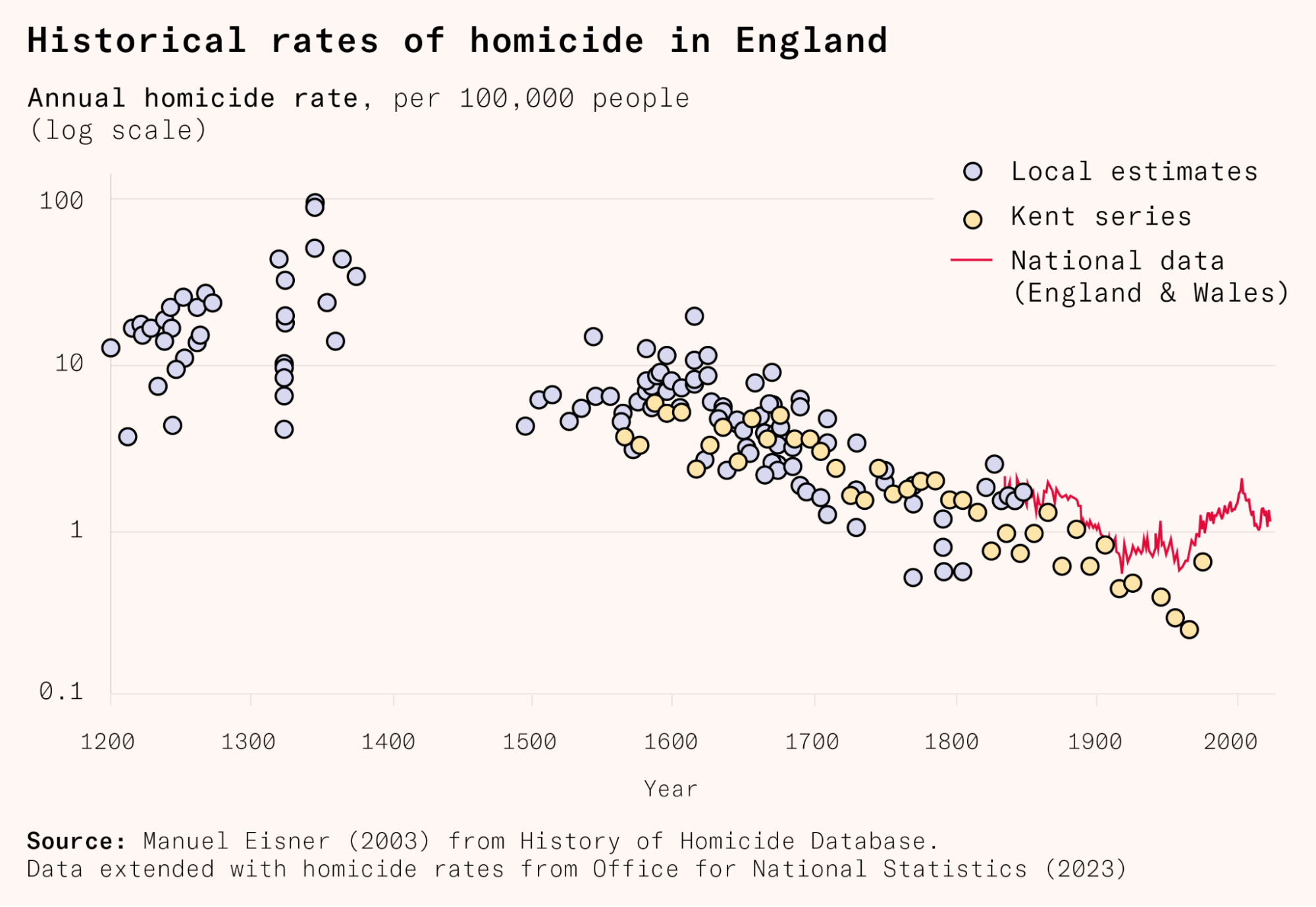
How the War on Drunk Driving Was Won, by Nick Cowen, is a ‘how to’ guide for changing antisocial behaviours to become prosocial ones, including not just drunk driving but even murder, which was vastly higher in the past than today.
Capitalism, free markets, and liberalism are substantially successful because they are a way of channeling competitive behaviours into prosocial outcomes, rather than negative sum outcomes, like footbinding, infibulation, or virtue or vice signalling. In a capitalist culture, which respects success and wealth, people can indulge their natural desire for social competition and generating status by doing things – jobs, or starting companies – that benefit lots of other people. Even spending money on luxurious country houses often leaves behind valuable culture for society. Whereas other social institutions for competition (for status and mates), like footbinding and infibulation seem to have been, leave us worse off than if no one competed at all. I think Ryan Murphy’s ASI paper The New Aristocrats is one of the best economic models of taste signalling.
I mentioned Ronald Coase above. Ronald Coase’s other article The Problem of Social Cost has been nearly as influential on me. (Today, I would skip this article and instead read The Importance of Alienability and Democracy is the Solution to Vetocracy by Sam Bowman.) Circumstances in society are generally Pareto efficient, because otherwise people would spend effort moving them toward a more efficient state, in exchange for a share of the efficiency gains. (But Pareto efficiency is far from enough!)
Fixing policy
Liberal advocates have a structural advantage over illiberal opponents because we offer efficiency gains. As long as we can come up with ways to turn those efficiency gains into better lives for a broad range of people, we should win nearly every political battle. There have been periods where this has happened, such as under Thatcherism. My view is that this is hard work, and most liberals prefer to own their enemies online in order to generate ingroup status instead.
In that spirit, I have spent a lot of the last five years thinking about Coasean approaches to housing reform. The NIMBY Problem by David Foster and Joseph Warren is one of the best encapsulations of why stuff doesn’t get built, and the sort of thing that could change that. Alex Morton’s Why Aren’t We Building Enough Attractive Homes was also a real eye opener when I read it, as was the work of John Myers.
I turned to Coasean approaches to housing reform as I steadily became more appreciative of the very real concerns of the so-called NIMBYs. Development really does often have large externalities, and the externalities of any given development usually fall heavily on one narrow group of people.
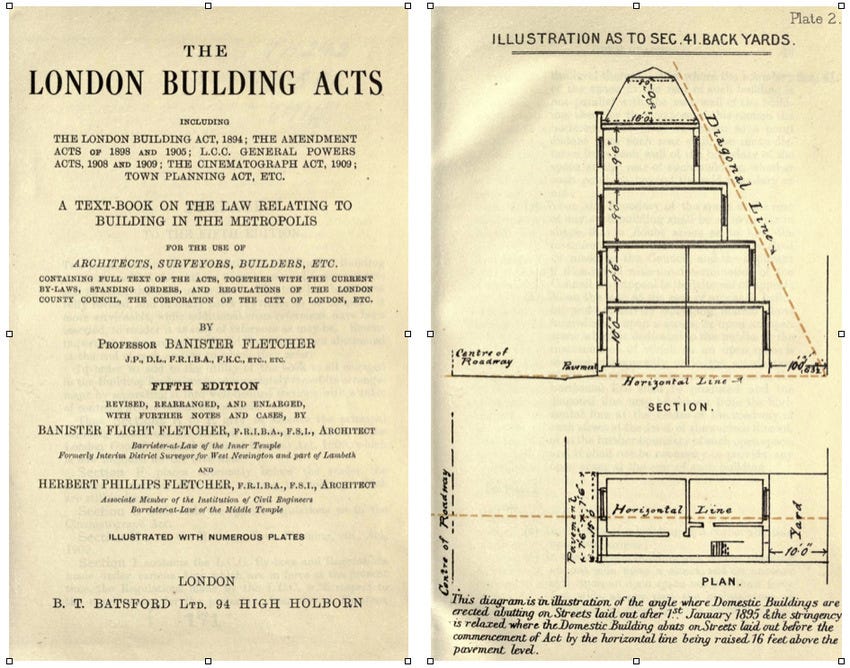
Donald Shoup’s idea of ‘Graduated Density Zoning’ – returning to the old system where landowners could build as much as they liked below ‘light planes’ – is a genius way to maximise the amount of development you allow subject to a constraint around light and congestion externalities. It mimics the private planning of the past, beautifully explained in John Kroencke’s book Private Planning and the Great Estates. (See also Samuel Hughes’s article The Great Downzoning for further insights on the benefits of planning.)
Private planning now forms a particularly important place in my thinking. Low-state-capacity cities in developing countries today have almost no limits on development – nor did medieval cities in the West. These cities were afflicted by chronic congestion, and therefore overcrowding, disease, and more. Landowners realised they could create more value by (privately) planning new neighbourhoods, such as Belgravia or Pimlico, rather than just selling them off. Even if they did want to sell leaseholds off, as in Georgian Bath or Edinburgh New Town, they required developers to keep to certain rules, like not encroaching on the roadway, facing their buildings in stone, and building to planned design patterns. The market chose planning. British city planning today leaves a lot to be desired, but the problem with it is not that it is planning.
Design is the ultimate externality. If you have a beautiful house, you will rarely see it. But if you live on a street of beautiful homes, you will enjoy the view every day. When it comes to cities, one of my key concerns is housing supply: just building enough homes in the right places in total. But another concern we might have is creating beautiful cities that we enjoy living in. Sometimes it feels like we live in the ruins of an older, greater civilisation (though in practically every other respect, we are vastly superior to our ancestors). The best things ever written on this topic are by Samuel Hughes. I have re-read each of his essays – In Praise of Pastiche, Against the Survival of the Prettiest, Making Architecture Easy, and The Beauty of Concrete – literally dozens of times.
Life begins at 35
Overall, my views have tended in some ways to moderate during my twenties and thirties. I have come to see that many of the hard-line distinctions I drew between things are not as tenable as I once thought they were, and at the same time that drawing hard-line distinctions between things is not as important as I thought it was.
For example, I now think that local governments have at many times and places functioned like ‘spatial companies’ – a kind of land-based company acting over one location – more like a private body than what we think of as the ‘state’. Local governments function like this in some places today, and in other places are deeply dysfunctional, corrupt, moribund, or sclerotic. State science funders like Darpa are more like private funders like Bell Labs than they are like the National Institutes of Health, or UK Research and Innovation. The usual distinctions – incentives, information, and evolutionary dynamics – are almost always the reason why, but this is true both for ‘state’ organisations and private ones.
In fact, I see myself as having come to apply these ideas – incentives, information, and evolution – to a much broader range of things. For example, it once seemed to me that the normal kind of private property rights were the only type of property, and everything else was invalid, or even an infringement of real rights. Now it seems to me that the reason behind property rights is protecting the incentive to accumulate: to do things that you will later benefit from. It seems to me that this principle applies to some extent to nations, cultures, institutions, and many other things as well, and that the entryism of illegal immigration is not so different from ‘woke’ entryism into state institutions, or other kinds of entryism. Similarly, I now think that sharing the benefits of growth with a broad swathe of society, through kinds of re- or pre-distribution are not so much an infringement of rights as a way to guarantee they continue to exist into the future.
As I grow older I gain more and more respect for the basic principles of our liberal society, and the basic wisdom of its institutions – and more keen to protect the bits of them that still make us successful.
Other novels that I like in part because of the ideas they touch on, rather than because they are good stories, include Blindsight by Peter Watts, The Three-Body Problem by Liu Cixin, and Marooned in Realtime by Vernor Vinge.
 | A guest post by
|