Merry Christmas!
Plus: Why is unemployment rising?


In today’s newsletter:
Merry Christmas from the IEA team!
Our 2025 highs and lows
Why is unemployment rising?
Why the real Grinch is the Government
I am writing this on the Eurostar en route through France, a country which long used to baffle me, as a free-market economist. How can France, which is such a statist, dirigiste economy, be as rich as it is?
France ranks 44th on the Economic Freedom of the World Index, while the UK ranks 13th. Neither is ideal - I’d aim for the top 5 - but these differences in degree usually matter.
Public spending in France is about 57% of GDP, compared to 45% in the UK. Again, neither is ideal: I’d aim for below 30%. But, again, differences in degree ought to matter, so why don’t they, in this case?
On the OECD’s Strictness of Employment Protection index, France scores 2.7 (on a scale from 0 to 6), while the UK scores 1.9. And so on. Yet despite all that - France is about as rich as Britain, if not marginally more so. Why? How?
The answer is actually remarkably simple. France can get away with a lot, because they do this one radical thing which Britain does not do: they build things.
France has almost 600 housing units per 1,000 inhabitants, while Britain has fewer than 450 - and the French ones are also, on average, considerably larger. France produces nearly 8,400 kilowatt-hours of electricity per person per annum, which is more than twice as much as Britain. Their road network, at over 1m km, is more than twice as long as the British one. I have not found good data comparing office space, retail space and other business premises, but I bet France has a lot more of all of those than Britain does.
That, in a nutshell, is the difference between the British and the French economy. The latter provides the key input factors that you need for a thriving economy, but then overtaxes and overregulates the people who want to make use of those factors. The British economy gives people greater freedom to make use of those input factors, but it needlessly constrains their overall supply.
Neither is ideal. My ideal economy would combine the best of both: an abundance of buildings, energy and infrastructure, combined with low levels of taxation and regulation.
Anyway - I am not just writing this because I am currently stuck on a Eurostar through France with nothing better to do (although that is a factor). I am writing it because my expectation of the Labour government was that it would make Britain a bit more French - both in a good and in a bad way.
Right from the start, I expected to disagree with the Labour government on anything to do with taxation, public spending and labour market policy. But I also expected to broadly agree with them on housing and planning policies, where I was hoping they might be a bit less beholden to NIMBY pressures than their predecessors.
The first part has certainly proved correct. Public spending, as mentioned, has gone up to 45% of GDP, as the current government is completely unable to get any spending cuts past its backbenchers. Taxation is set to increase to the highest level ever recorded. The Employment Rights Bill has needlessly undermined what used to be one of Britain’s greatest assets, namely, a labour market that was able to create lots of jobs even when growth was lacklustre. We are importing some of the worst aspects of the French economy.
Are we at least importing some of the good bits as well?
After last November’s Budget, my answer was no. It looked as though we were, instead, getting the worst of both worlds: British NIMBYism meets French dirigisme - a match made in hell.
However, two recent announcements make me end the year on a cautiously more hopeful note. Firstly, the government intends to implement the recommendations of the John Fingleton Review on nuclear energy, which has the potential to lead to a big increase in energy supply. Secondly, judging from the latest planning announcements, the government is belatedly remembering its ‘YIMBY‘ agenda. I will write about those plans in more detail next year, but for now, let me single out one particularly welcome measure: a default planning approval for medium-to-high-density developments around commuter stations. The measure is welcome because Britain criminally underutilises prime real estate around those stations, and we could add millions of homes in already well-connected places in this way.
So overall, there is, as so often, good and bad under this government. The problem is just that all the bad things are already happening, and without facing much resistance, while all the good things are still uphill struggles which have not yet been won.
The job of the IEA next year will be to consistently make the case for a liberal abundance economy, supporting whatever takes us closer to that goal, and pushing back against whatever takes us further away from it.
Until then - Merry Christmas!
Kristian Niemietz
Editorial Director
The best way to never miss out on IEA work, get access to exclusive content, and support our research and educational programmes is to become a paid IEA Insider.
IEA Podcast: Director of Communications Callum Price is joined by Managing Editor Daniel Freeman and Editorial Director Kristian Niemietz to review 2025 — IEA YouTube
Government’s ‘cack-handed’ policy choices hits jobs

Commenting on this week’s labour market figures, Professor Len Shackleton, Editorial and Research Fellow at the free market think tank the Institute of Economic Affairs, said:
“Today’s labour market figures show a predictable deterioration. The headline is the 5.1% unemployment rate, which, apart from a brief blip for Covid, is the highest in a decade. It is worryingly high for new entrants to the jobs market – 13.4% for 18-24 year-olds. If you are effectively locked out of a job in your first years after graduation or leaving school, it is very difficult to build a sustainable career in the years ahead. No wonder mental health problems are surging for young people.
“Most of the other indicators are also going in the wrong direction, with the total of those in employment falling. Small changes in these figures are not very reliable, and come from three separate sources, but it’s difficult to deny that it’s a gloomy picture for the private sector, where employment is falling overall and particularly amongst the woefully neglected self-employed. Public sector employment, however, continues to expand, albeit slowly. Caveats apply, of course, but the public sector also appears to be doing better in pay, with earnings up by 7.6% on an annual basis, as against just 3.9% in the private sector. Vacancies are down again.
“None of this is surprising, given the increase in employers’ national insurance contributions, the rise in minimum wages (especially sharp for younger workers) and the looming regulatory changes in the Employment Rights Bill. This last week, a further worry for employers is the lifting of the cap on compensation for unfair dismissal, purportedly a quid pro quo for the concession over Day One rights, but which may, in the longer term, be even more problematic.
“The last government did many things wrong, but its employment record – in particular the surprisingly rapid recovery after Covid – was not at all bad. The current deterioration, which may herald a real recession, is down to this Government’s cack-handed and doctrinaire policy choices. They will have to own it.”
News and Views
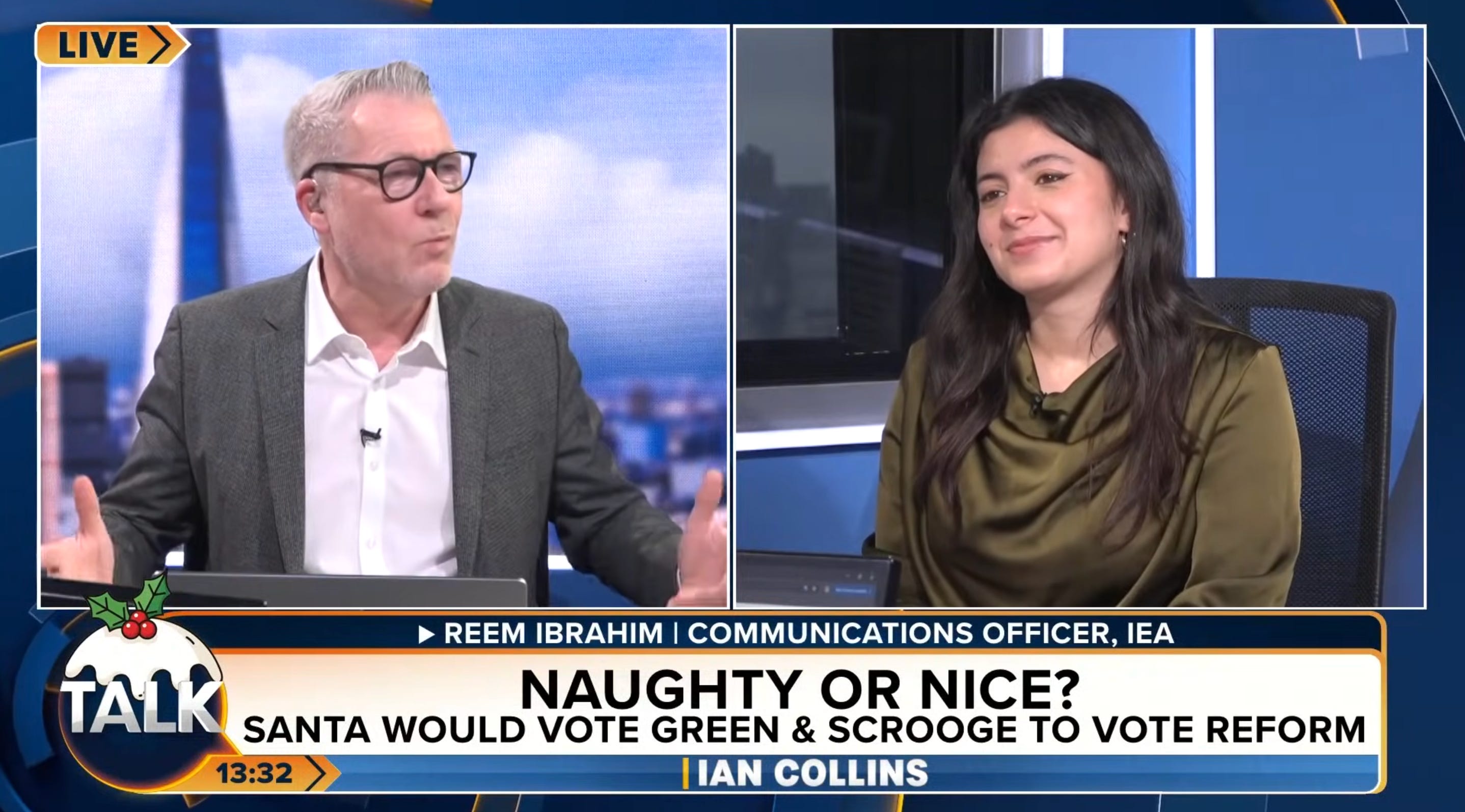
Merry Christmas – despite the government grinches, Head of Media Reem Ibrahim, CapX
Christmas is just around the corner. Brits across the country are preparing their mince pies, filling stockings with gifts for loved ones and stocking up on booze. Yet despite the festive cheer, the Grinch is trying to steal Christmas once again. Not the green, Christmas-hating monster. No, this is a more familiar fun sponge. Our Grinch is the Government.
The Shocking History of Wealth Taxes | IEA Briefing, Director of Communications Callum Price interviews Editorial Director Kristian Niemietz, IEA YouTube
Rachel Reeves told to get a grip as PIP benefit claims for ADHD rise by 16,000, Editorial and Research Fellow Len Shackleton quoted in the Daily Express
Reacting to the reported figures, Len Shackleton, an editorial and research fellow at the Institute for Economic Affairs (IEA) and professor of economics at the University of Buckingham, told The Express: “If we continue to acquiesce in the never-ending increase in benefit spending, we risk being unable to spend enough on the core functions of the state, such as defence and police. This potentially puts us all in danger.
Bank of England warning: UK economy faces ZERO GDP growth as ‘technical’ recession fears ‘rise’, Economics Fellow Julian Jessop quoted in GB News
Julian Jessop, an economics fellow at the Institute of Economic Affairs said: “The news that inflation is falling more quickly than expected is mostly welcome, but it may also be a warning that the risks of recession are rising.
The UK’s £20 Billion Budget Gamble Explained | IEA Interview, Director of Communications Callum Price interviews UK Political Correspondent for Bloomberg Joe Mayes, IEA YouTube
Donald Trump has destroyed American conservatism, Research Associate Mani Basharzad in CapX
The Republican Party was once the party of business. As the old saying goes, ‘the business of America is business’. But Trump’s relationship with billionaires is not business-friendly; it is cronyistic. You are welcome inside the circle only if you obey the economic daddy – as when Apple is pressured to bring manufacturing back to the US, raising costs and reviving jobs few Americans want. Increasing costs on one of your country’s most important companies and bringing jobs to America which no American wants to do it isn’t business-friendly, is it?
Yes, Trump destroyed the Democratic Party. But he did so at the cost of killing conservative sensibility itself.
Starmer stands accused of ‘caving in to EU’ over £570m student swap deal, Economics Fellow Julian Jessop quoted in the Daily Express
Economist Julian Jessop of the IEA think tank added: “At first sight, this is a bad deal for the taxpayer... Over the longer term the UK will presumably be a substantial net contributor to the costs of the scheme.”
Head of Media Reem Ibrahim appeared on TalkTV