Job(s) news!
Plus: how they (maybe didn't) break Britain., and the rest is IEA


In today’s newsletter:
A new era dawns at the IEA
Who are the millennial liberals?
The start of the inflation shock
The latest jobs figures published by the government this week initially seemed like a surprise - the headline figures are going in the right direction. Overall unemployment reduced from from 5.2% to 4.9% in the three months to February. Could it be that we’ve topped out on the consequences of this government’s triple-threat approach to job destruction: raising the minimum wage, raising taxes on businesses hiring people, and the Employment Rights Act? Unfortunately not.
As our own Len Shackleton points out, the fall in unemployed (60,000) is more than matched by the rise in those becoming economically inactive completely - are people getting jobs or just giving up? What’s more, the story for young people continues to get worse, as employment for the young falls again. This is confirming further still what we already know: young people are bearing the brunt of the government’s approach to work.
And what about the coming AI-pocalypse? Well, according to think tank friends the Centre for British Progress, the effect of AI on jobs in the UK is yet to really take hold. They have found, three years after the launch of ChatGPT, that there is no evidence that AI has replaced jobs at scale in the UK. There are some interesting details, like an uptick in some jobs that are AI-exposed such as programmers and finance analysts, with a drop in others, like clerical and administrative roles. But as Daniel Freeman notes on this week’s podcast, other revolutionary technologies took decades, rather than years, to be felt in the broader economy. What seems to be clear is that damaging Government action is the bigger threat to jobs in the immediate future.
Fortunately, at least one job vacancy has been filled this week, as Lord Hannan of Kingsclere is announced as our new Director General here at the IEA. We are delighted to be welcoming such a renowned, dedicated, and formidable advocate of liberty into the IEA fold to lead us into a new era, and look forward to him taking the reins in June.
Callum Price
Director of Communications
The best way to never miss out on IEA work, get access to exclusive content, and support our research and educational programmes is to become a paid IEA Insider.
IEA Podcast: Director of Communications Callum Price is joined by Managing Editor Daniel Freeman and Energy Analyst Andy Mayer to discuss AI and the jobs market, and Miliband’s latest energy efforts - IEA YouTube
Lord Hannan of Kingsclere will be joining as the IEA’s new Director General
The Board of Trustees of the Institute of Economic Affairs (IEA) is delighted to announce that Daniel Hannan, Lord Hannan of Kingsclere, will become Director General and Ralph Harris Fellow of the Institute from 1 June 2026.
His appointment marks a new chapter for the IEA — one focused on making the case for freedom, free markets, and limited government with renewed energy, broader reach, and the uncompromising intellectual clarity the Institute has always stood for.
Lord Hannan of Kingsclere, incoming Director General of the Institute of Economic Affairs, said:
“The IEA set Britain free. When it was founded in 1955, there was a consensus in favour of high spending, industrial management and economic planning. Ralph Harris and Arthur Seldon showed people what was wrong with those ideas, and thus unleashed the genius of our nation.
“We face a similar challenge today. Public spending and taxation are higher now than they were in 1955. We are back to the fatal conceit, the idea that politicians, bureaucrats and planners know best.
“Just like the IEA’s founders, we need to change people’s minds, to open people’s eyes. The route to national prosperity, now as then, is through deregulation, free trade, sound money and low spending. It’s not just the politicians we need to convince; it’s not even primarily the politicians. When voters understand the case for smaller government, MPs follow.
“I am so grateful to every one of my predecessors, from Ralph Harris, who inspired me as a teenager, to David Frost, whom I am proud to call my friend. They kept the flame burning. Now it is time to heap up the fire.”
Linda Edwards, Chairman of the IEA Board of Trustees, said:
“Lord Hannan is one of those rare figures who combines serious intellectual depth with the ability to communicate ideas to a genuinely mass audience — and to do so with energy and conviction that is entirely his own. He does not merely hold the right views; he has spent his life persuading others to share them. That is exactly what the IEA needs.
“The founders of this Institute understood something that is easy to forget: that advances in public understanding begin with advances in rigorous thinking. You do not shift the terms of serious debate by trimming your conclusions to what is currently fashionable. You shift them by examining the evidence carefully and making the argument, with patience and with rigour. Daniel has been doing that his entire career. I have every confidence that under his leadership the IEA will enter a period of exceptional impact.
“I also want to express the Board’s warmest thanks to Lord Frost for his service as Interim Director General. He brought to the role the same seriousness of purpose and clarity of principle that have always characterised his public life, and he leaves the IEA in strong shape. We are delighted that he will remain closely connected to the work of the Institute in his new role as Senior Policy Fellow.”
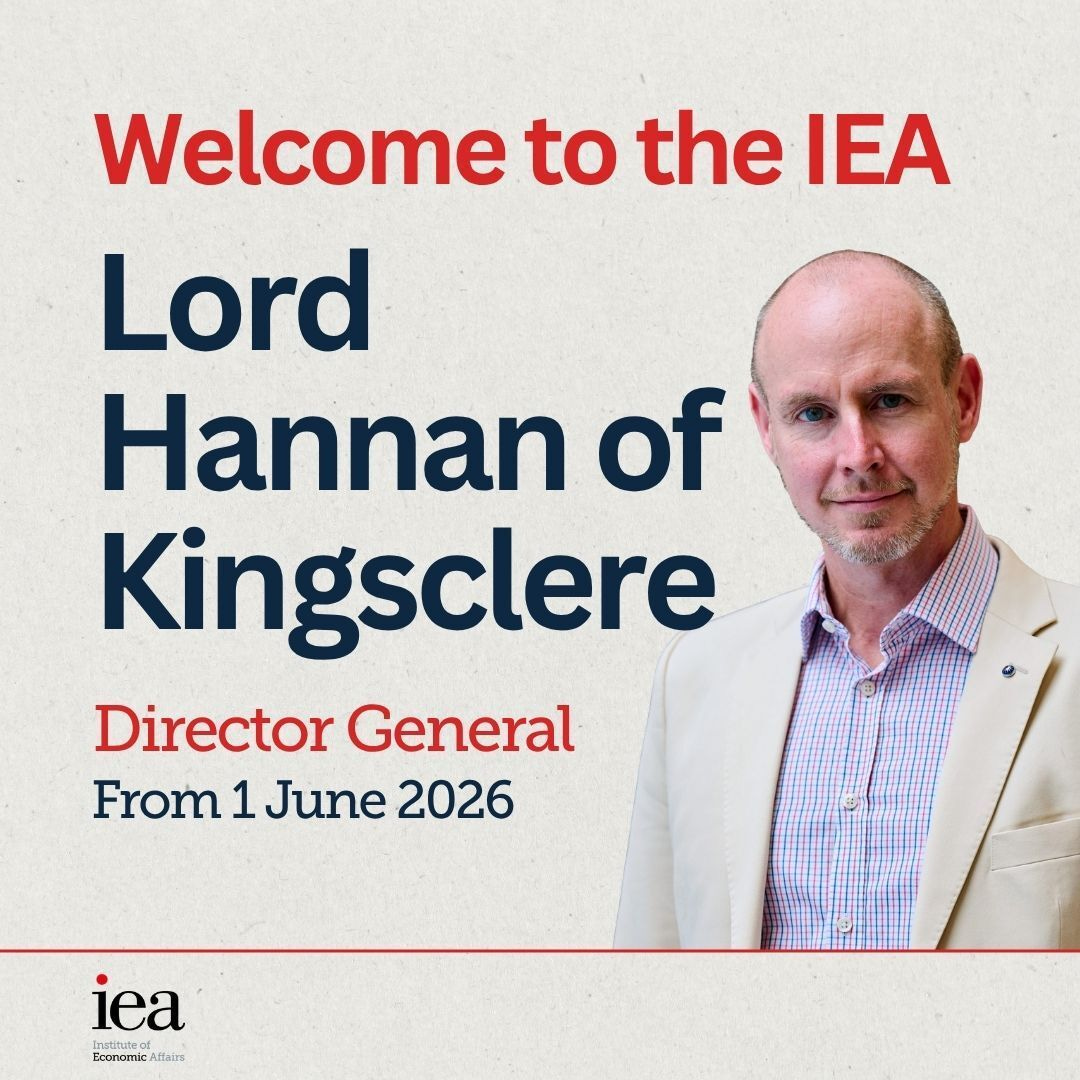
Lord Hannan appointed IEA DG, read more on Guido Fawkes
The UK is only in the early stages of the inflation shock
Commenting on the inflation figures, Julian Jessop, Economics Fellow at the Institute of Economic Affairs said:
“The jump in UK inflation from 3.0% to 3.3% in March is bad news but not quite as bad as some feared (the Bank of England expected the rate to be “close to 3½%”).
“Moreover, this jump can be entirely accounted for by the increases in transport costs (mainly motor fuels), which is hopefully a one-off.
“The Bank’s Monetary Policy Committee may also be reassured by the news that core inflation (excluding food and energy) ticked down from 3.2% to 3.1%.
“Nonetheless, these numbers are too high for comfort, and the headline rate is moving even further away from the MPC’s 2% target.
“This is also just the early stages of the latest inflation shock. It will take several months for the jumps in the costs of fuel and other commodities to be passed through in full to the prices of other goods and services.
“It is also too soon to judge whether there will be any other second round effects, notably a sustained increase in inflation expectations.
“In the near term, inflation will probably fall back in April, reflecting the reduction in this month’s Ofgem cap on domestic energy bills and some favourable effects from other regulated prices.
“But pipeline pressures are building elsewhere and, unless the government intervenes further, the Ofgem cap is going up again in July.
“That said, two factors should prevent inflation from taking off – and mean that the Bank of England can keep interest rates on hold despite the inflation risks.
“First, demand is weak. Firms have little pricing power, other than on essential goods and services, and the softness of the labour market means that wage growth is likely to remain subdued.
“Second, the supply of broad money (specifically, “M4ex”) has been growing at an acceptable pace of around 4%. This means that increases in the prices of the goods and services most affected by the Iran war are more likely to be offset by falls, or smaller increases, in the prices of others.
“In contrast, growth in broad money peaked above 15% in 2021 as the Bank of England monetised the surge in government borrowing during the pandemic. This then helped to fuel the spike in inflation in 2022 as energy prices jumped following Russia’s full scale assault on Ukraine.
“In short, unless the Middle East crisis escalates further, UK inflation will probably be capped at around 4% this year and then fall sharply next year.
“But this is still a major shock, with the economy set to flatline at best in the second quarter and possibly the third too.”
Bank of England ‘flying blind on inflation’, read more in The Telegraph
News and Views
Britons are now working like Americans, IEA research on the differences between expectations and reality of the UK’s economic performance compared to the USA covered in the Financial Times

The hidden costs of capping CEO pay, Professor Len Shackleton writes on the Green Party’s latest policy in CapX
“With markedly reduced upper earnings, saving to start your own business would become well-nigh impossible. And private donations to charities would become insignificant. No more privately-funded new buildings for national institutions. Independent initiatives of all kinds would be discouraged. The state would have to expand its reach still further, with all economic and cultural activity increasingly in its hands – and taxation rising to match.”

Are all millennials socialists? Callum Price interviews Kristian Niemietz about the new IEA Insider series ‘Millenial Liberalism’, IEA YouTube
Proposed consumer lawsuit regime may expose businesses to mass litigation, IEA research on class action lawsuits covered in CityAM

How will the smoking ban work? Christopher Snowdon quoted on the folly of the generational smoking ban in the Daily Mail
‘Most people can easily buy a pack of illicit cigarettes for £5 and the people who sell them don’t care how old their customers are,’ he told the Daily Mail.
‘Most tobacco in Australia is now illegal thanks to high taxes and we are heading in the same direction. The generational sales ban will only accelerate that.’
Events and Opportunities
Opportunity: Want to help shape the big decisions of our time?
The Public Policy Bootcamp (3-5 June, University of Buckingham) is a 2.5-day residential deep dive into today’s key challenges (from global trade to fiscal policy) hosted by the IEA and the Vinson Centre. Open to early-career professionals across politics & research.