It's time to talk trade-offs
Plus: Britain should trade faster and Freedom Week applications open

In today’s newsletter:
A guide to Hayek
Triple-locked in
Does Britain need a second London?
This week, Simon Dudley was sacked as the housing spokesman for Reform UK for saying in an interview, seemingly in the context of housing regulation after the Grenfell tower disaster, that “everyone dies in the end. It’s just how you go, right?”
Undoubtedly his words, seemingly a little off the cuff, were ill chosen. Still, the wider interview makes the perfectly reasonable point that there are trade-offs in housing policy as in everything else. It is certainly arguable that certain post-Grenfell changes in regulation, notably the requirement that most tall buildings must have a second staircase, have been part of the reason why house building in London has virtually stalled. It’s certainly not the only reason - the insistence on high proportions of “affordable” (aka subsidised) housing is also part of it, as are many other things - but there is definitely a policy problem and it is reasonable to try to get the balance right between all the competing factors.
Expressing difficult trade-offs is one of the most difficult things in modern politics. I got a little taste of it myself a few months back when I wrote a piece in the Telegraph on the government’s latest crackdown on speeding. I argued that Britain already has one of the best records in road safety anywhere in the world, and accordingly that it shouldn’t be a policy priority for spending our (extremely limited) public funds. That didn’t stop me receiving lots of comments to the effect that “one death is one too many”. Well, in that case, the only thing to do is ban cars altogether.
The Green Party may yet take us there. But in real life most of us can make the trade offs and we mostly understand the nature of the choices. But our adversarial political system makes it very difficult to express these issues without a degree of risk. Choose your words less than carefully, and they will be distorted and thrown back at you. I doubt anyone believes, even his worst political opponents, that Simon Dudley is actually in favour of people burning to death in tall buildings if it helps the profits of building companies. But Nigel Farage no doubt thought Dudley’s words would be weaponised to that effect, and therefore that it was better and safer to cut him loose, despite his genuine and undoubtedly much-needed expertise.
I understand that decision given our current political environment. Still, wouldn’t it be better if all of us - and especially those who so often call for a kinder gentler politics - could occasionally give politicians the benefit of the doubt? Instead of howling for someone’s head, just say “he didn’t express himself well. He should be more careful next time. But we still need to deal with the point he was trying to make.” I’m not holding my breath.
Lord Frost
Director General
The best way to never miss out on IEA work, get access to exclusive content, and support our research and educational programmes is to become a paid IEA Insider.
IEA Podcast: Director of Communications Callum Price is joined by Editorial Director Kristian Niemietz and Director General Lord Frost to discuss Reform UK’s triple lock promise, a new free speech bill, and honesty about trade offs in public debate - IEA YouTube
Hayek’s Law Legislation and Liberty: A Guide
One of the most important defences of individual freedom ever written remains essential reading for anyone seeking to understand why government overreach, populism and demands for ‘social justice’ continue to threaten the foundations of a free society, according to a new book by Eamonn Butler.
The book provides an accessible introduction to Hayek’s Law, Legislation and Liberty, making one of the twentieth century’s most important works of political philosophy available to a wider audience
Hayek’s warnings about the expansion of government power, the hollowness of ‘social justice’ and the erosion of the rule of law anticipated many of today’s most pressing political debates
The book argues that cultural evolution — not top-down design — produced the institutions on which our freedom and prosperity depend, and that attempts to redesign them wholesale risk profound damage


News and Views
Triple lock an electoral bribe with a compound interest rate
Responding to Reform UK’s pledge to keep the triple lock, Dr Kristian Niemietz, Editorial Director of the IEA said:
“Reform UK’s commitment to the pensions triple lock is hugely disappointing. It confirms that no major party is willing to be honest with voters about the cost of Britain’s growing pension obligations.
“The triple lock is one of the most expensive commitments in British public policy, it is an electoral bribe with a compound interest rate. It ratchets up spending year after year, including under economic conditions which really do not warrant it. It is a poorly targeted benefit, much of which goes to already well-off pensioners, paid for by working-age people who get a raw deal from our stagnant economy.
“While pledges to make cuts elsewhere are welcome, a party that claims to stand for radical reform and fiscal responsibility should be leading the argument for a sustainable pension settlement, not bidding for grey votes with the same unaffordable promises as everyone else.
“We need to talk about containing the cost of the current system in the short term, but also, in the longer term, about how to move to a system with a more stable funding base less amenable to political meddling. We need to give people the opportunity to build up their own savings throughout their working lives, so that they are not reliant on political bribes in old age.”
State pension triple lock pledge from Reform slammed as ‘hugely disappointing’, GB News
Nigel Farage issues state pension pledge as Reform UK vows to keep the ‘triple lock’, The Daily Express
How ‘nanny state’ rules have hit Easter, Chris Snowdon slams the ‘nanny state on steroids’ in The Sun
“Policies are supposed to be about childhood obesity and junk food, but it’s ordinary adults buying ordinary products who pay the price.”
Does Britain Need a Second London? Professor Ed Glaeser delivers the 33rd Hayek Lecture, IEA YouTube
The myth of laissez-faire Britain, Kristian Niemietz asks where the so-called ‘passive state’ has been in the UK for so long, CapX
‘Everybody’s making money’: how two backstreets become the vape capital of Britain, Chris Snowdon quoted on the consequences of nanny state measures in The Guardian
The head of lifestyle economics at the Institute of Economic Affairs, Dr Chris Snowdon, stresses the risk of removing choice: increasing costs could push smokers back to cigarettes and drive “importing or buying on the black market”. That would be a catastrophe for what he sees as a “competitive” market.
Shrink the state, Lord Frost spoke to Fighting for a Freer Future:

Made in Britain, Daniel Freeman interviews Dr Gregory Clark on the 500-Year Story Behind the Industrial Revolution, IEA YouTube
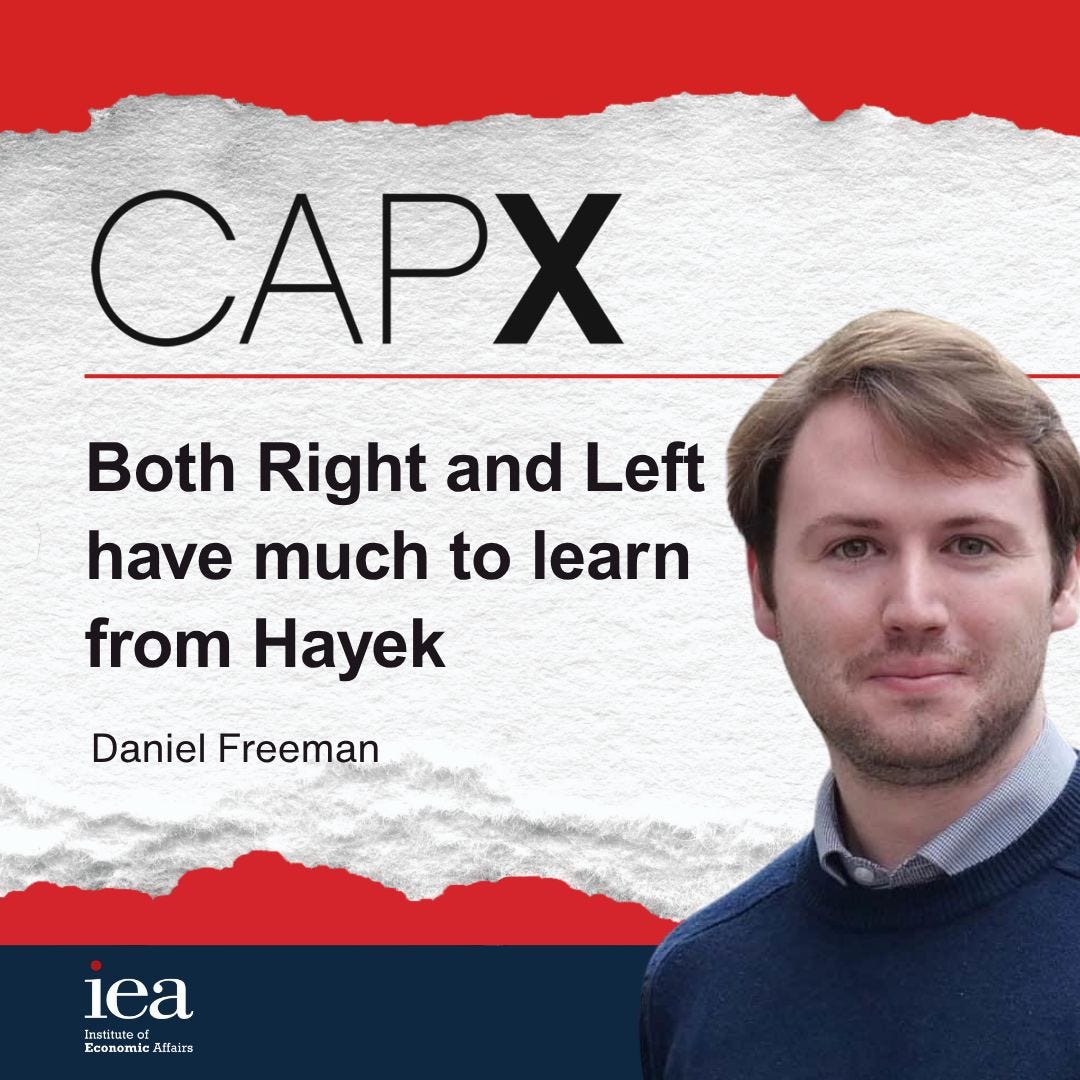
Both Right and Left have much to learn from Hayek, Daniel Freeman writes on why Hayek’s warnings about state coercion and the limits of human knowledge are more relevant than ever, CapX
The government has handled the energy crisis badly, Julian Jessop speaks to Times Radio:
How Capitalism Dies, capitalism has created a cultural elite hellbent on its destruction Mani Basharzad writes in CapX
Events and Opportunities
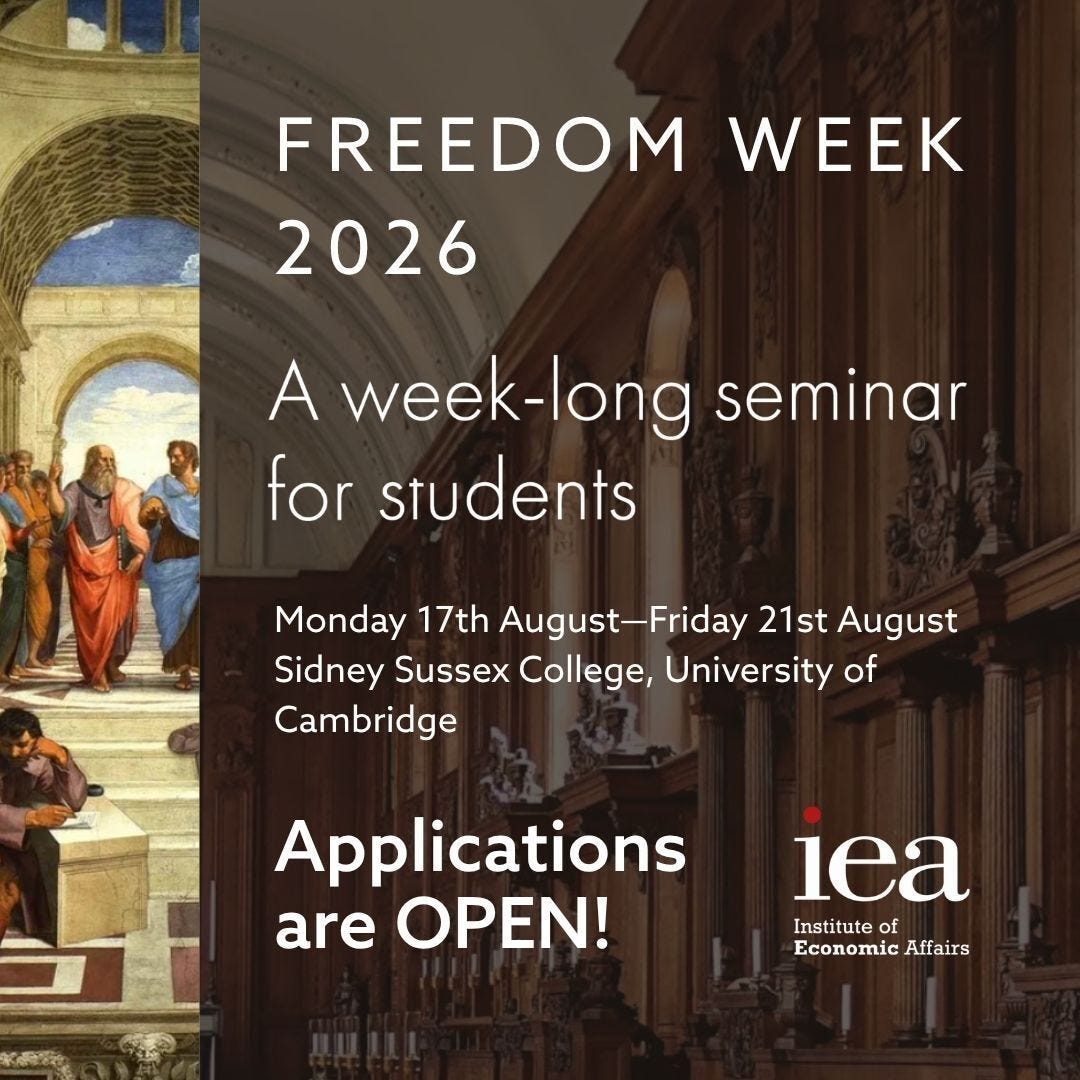
Applications are NOW OPEN for Freedom Week 2026!
Join us for a fully-funded week-long conference at Sidney Sussex College, Cambridge (17-21 August) exploring classical liberalism, free markets, & the ideas of liberty.
University students/recent graduates: don’t miss out, this is completely FREE (accommodation, food, everything!).