

Interest rate debates
Plus: Brexit reset and is flexible work working?


In today’s newsletter:
We shouldn't use interest rates as a growth tool
The costs of mandating flexible work
Brexit reset latest
This week, the Bank of England decided to keep interest rates on hold. No particular surprise there. But still everyone believes rates will be coming down again soon. But why? It is surely obvious that the Bank does not yet have a proper grip on inflation. The average voter will laugh in your face if you tell them that prices are now under control. The psychology of inflation got established during the pandemic and it will be very difficult to make it disappear once again. I fear that the Bank is being far too optimistic.
It is hard to avoid the suspicion that the government and the commentariat is willing to say that inflation is under control not because it is right but because it is convenient. They want interest rates down because they see low interest rates as a tool to get the economy growing again. That, after all, is what has happened repeatedly over the last thirty years. Every time there has been a crisis, interest rates have been pushed down by central banks. Each time the floor was lower, until we reached negative rates and QE across much of the Western world, because each time it took lower rates to deliver the same economic stimulus.
Why is this? Because interest rates have an important economic function. When they are at something like normal levels, they ensure that investment flows to where the returns are highest. Equally, unviable companies and unprofitable sectors are wound up as capital flows elsewhere. This ensures that the motor of a capitalist economy - innovation, investment, profits - keeps working.
This has not happened properly across much of the West, especially Europe, in recent decades. Zombie firms have survived when they shouldn’t have. Innovation of all kinds has not been invested in as it should have. Artificial stimulus must be taken in larger and larger quantities to deliver the same effect. Productivity slowly declines, growth follows, until we have the situation we have today.
That’s why we mustn’t resort to low interest rates as a growth tool. If anything, we need rates to stay at normal levels for longer. Not only will this squeeze inflation out of the system, it will start the process of liquidating malinvestment and shifting capital and profits into growth areas - and start getting us rich again. The best thing governments can do to make this happen is not to start picking winners themselves, but to get out of the way and start allowing market forces to work properly once again.
Lord Frost
Director General
The best way to never miss out on IEA work, get access to exclusive content, and support our research and educational programmes is to become a paid IEA Insider.
IEA Podcast: Director of Communications Callum Price is joined by Director General David Frost and Editorial Director Kristian Niemietz to discuss the Brexit reset, the state of the economy, and flexible working - IEA YouTube
New Publication: Is Flexible Working?
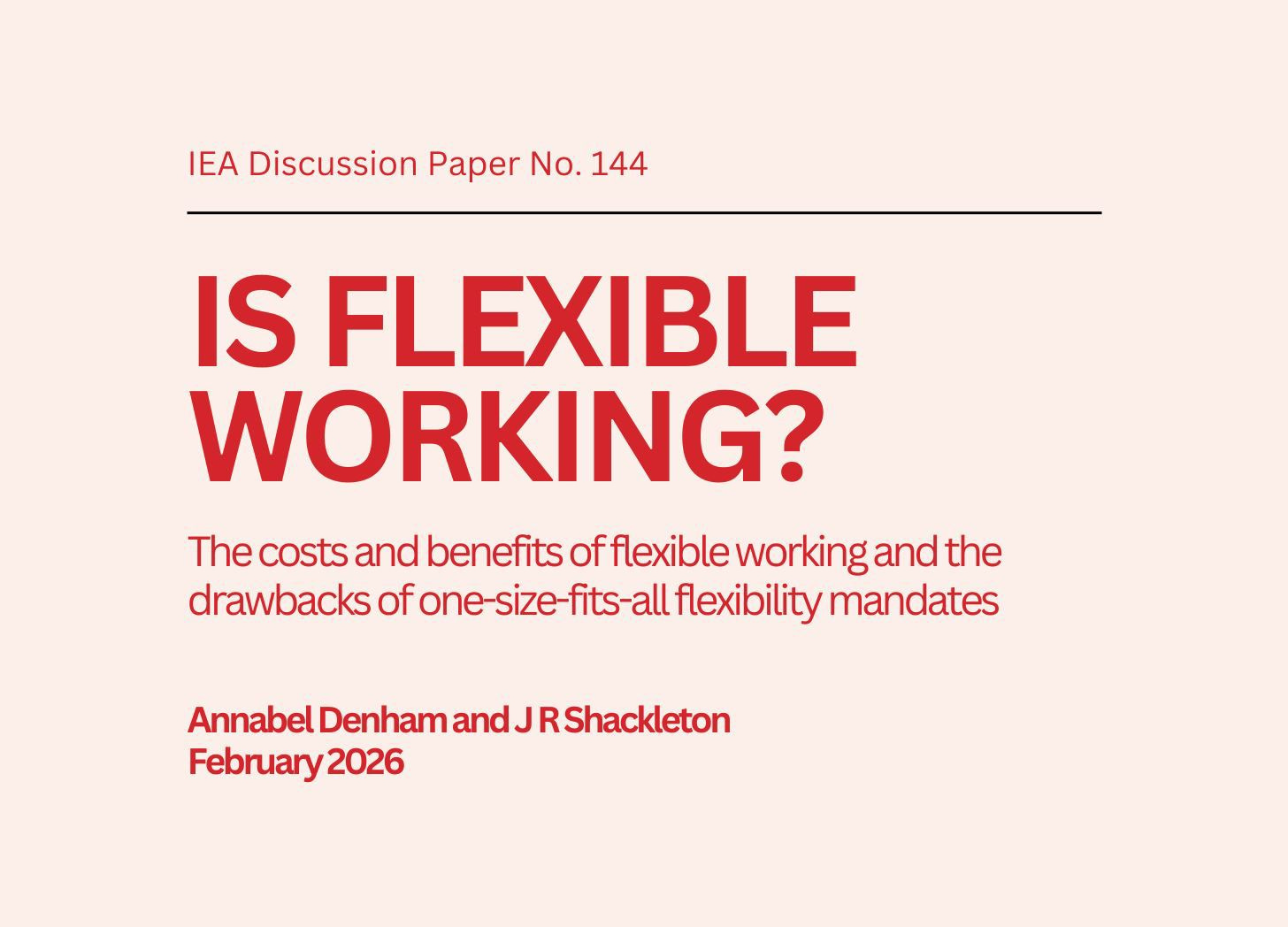
By Professor Len Shackleton and Annabel Denham
Governments are constantly tempted to push flexible working because it allows them to support a popular social change without having to pay for it themselves.
The new, stronger “right to request” flexible working in the Employment Rights Act will be much harder for managers to resist, and even dealing with such requests will impose costs on companies.
While private businesses may be able to control some of these costs, the widespread strengthening of flexible working rights is likely to damage productivity, slow growth, and undermine wages and employment
This will be all the more true if unions or workplace rules stop wages adjusting, for example to reflect whether particular jobs can in practice be done remotely. This is likely to be a particular problem in the public sector, reinforcing its existing poor productivity record.
Who pays for flexible working? Len Shackleton writes in CityAM
Flexible working isn’t a free lunch, Len Shackleton in CapX
WORKING IT OUT Labour’s new workers rights act is a ‘backdoor’ stealth tax that will leave families poorer, experts warn, The Sun
Flexible Working Mandates: Good Intentions, Terrible Results, IEA YouTube
News and Views
SMPC Votes to Cut UK Base Rate by 25bps
At its quarterly (hybrid) meeting on 13 January 2026, the Shadow Monetary Policy Committee (SMPC), hosted by the Institute of Economic Affairs (IEA), voted by a 5:4 majority to cut the UK Base Rate by 25 basis points, bringing it to 3.5%. The committee also voted to maintain Quantitative Tightening (QT) at its current pace. A majority expressed no bias toward further rate cuts, adopting a “wait and see” approach.

Commenting on the Bank of England’s decision to hold interest rates, Julian Jessop, Economics Fellow at the Institute of Economic Affairs said:
“The Bank of England’s decision to keep interest rates on hold today was no surprise, but the 5-4 vote was much closer than most had anticipated. Unfortunately, this dovish tilt owes more to rising concerns about growth and jobs than to increasing optimism about inflation.
“In particular, Bank staff nudged down their GDP forecast for 2026 from 1.2% to just 0.9%. This would be slower than last year’s estimated 1.4% and, more worryingly, a full half a percent lower than the OBR’s forecast of 1.4% for 2026 which was baked into the last Budget…
“This might have been enough to tip the balance towards a rate cut. However, the Bank of England has been unable to ease policy as quickly as many other central banks because of the UK’s relatively high rate of inflation. This mainly results from government policies, notably on tax, energy prices, and the labour market…”
Chancellor already out of headroom despite tax rises, Lord Frost quote in The Telegraph
Lord Frost, director general of the Institute of Economic Affairs, said the forecasts showed the “perilous state” of the public finances and argued that the Government was making the situation worse.
“Hiking taxes, spending, and regulation on workers is fatal for economic growth,” he said.
“We are seeing laid bare the costs of the Government’s national insurance and minimum wage hikes, and Employment Rights Act: a spike in the cost of hiring entry-level workers, meaning fewer jobs and opportunities for young people.”
Why Britain needs a Milei, Kristian Niemietz discusses British Afuera and reforming the state pension system, IEA YouTube
Lord Frost wrote to the Financial Times on the Government’s ‘Brexit Reset’
“The government’s efforts would be better expended on using the benefits of British national independence, while we still have it, to deregulate and improve the business environment here in the UK. Such action would do far more to help the benighted British economy than surreptitiously binding ourselves once more, bit by bit, to the slow-growth EU.”
The problem with protectionism, Chris Snowdon in The Critic

“I don’t know why getting closer to slower growing economies is thought to improve the British economy.” Lord Frost on BBC Politics Live

The inverse virtous circle of the British economy, Lord Frost on TalkTV
From Extinction Rebellion to Nuclear Advocacy, Chris Snowdon interviews Zion Lights, IEA YouTube