

The following is a lightly edited version of a speech delivered on 19 March by Lord Frost at the Free Market Roadshow, Budapest, under the auspices of the Danube Institute and the Austrian Economics Centre.
Can free markets save the West? My answer is they can help save it - but they are only part of the solution.
The West’s problems are undoubtedly in significant part economic. In Europe above all, we have built societies of slow growth and increasing collectivism. But our problems are also political, cultural and democratic. We seem to lack confidence in our own values and the institutional and cultural frameworks which brought success. If we are serious about revival, we have to understand all these things together. We are not dealing simply with a growth problem. That problem is itself a symptom, in part, of a wider crisis of confidence in the institutions, habits and loyalties on which free societies depend.
The nature of the growth problem
But let us look at the growth issue first. As we can see it is mainly a European problem.
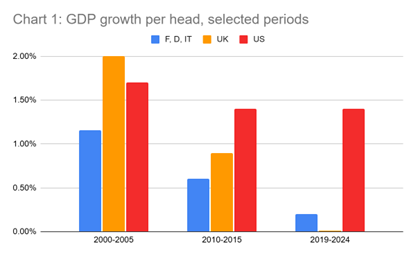
The fall in growth has been more dramatic in Europe’s leading economies than in the US. America has continued to generate growth in a way that Europe has simply not. (I’ll come back to the UK story in a moment.)
Why has this happened? Why is Europe’s growth so poor?
I point to three factors. First, high and increasing levels of tax and spend.
Second, energy policy, and in particular the impact of net zero. Third, and without exaggerating it, the removal of the UK as a competing European economic model - not because of Brexit, but because of a long series of British choices which began well before it.
Let’s look at these in turn.

Tax and Spend
The great continental economies at the production frontier - France, Germany and Italy - were already in the year 2000 high-tax, high-spend societies by the standards of the developed world. Since then, they have gone further still, as Chart 2 shows.
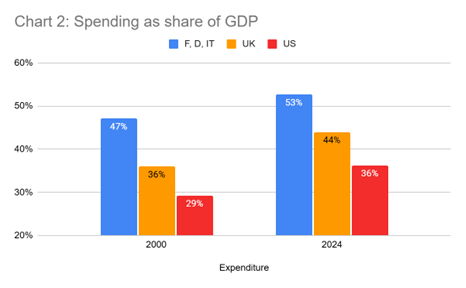
The United States has also seen an increase too. This is not a problem unique to Europe. But America started from a much lower base and has remained, by comparative standards, a relatively low-tax, low-spend economy. That difference matters.
It matters because states do not spend or tax in a vacuum. High levels of taxation absorb resources, distort incentives, and direct effort away from useful economic activity and towards transfer, administration and compliance. And over time, if you do enough of that, you reduce the energy, dynamism and risk-taking which growth depends on. You also change the tone of politics itself. The larger the state becomes, the more politics becomes a struggle over slices of a fixed pie, and the less it is about creating new wealth.
That is especially true in economies already at the frontier. If you are France or Germany or Britain, to get growth you need entrepreneurship, innovation, productivity improvement, and experimentation of all kinds. You need, in short, a system that rewards successful effort and allows failures to be rapidly liquidated. Instead we have systems that entrench incumbents, protect insiders and make every decision more political. And that is showing up in the growth figures.
Energy
Then there is the second factor: energy.
Since the mid-2000s - really since the beginning of the climate panic - energy consumption per head has fallen across Europe. In the EU27 it is down by roughly 20%. In the UK it is down by 40%.
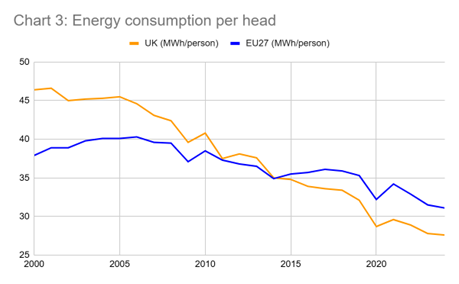
This is the result of deliberate policy. We have chosen to make energy, and particularly electricity, more expensive by a forced transition to renewables. It is a a system of state-directed shortage and unpredictability in one of the most basic inputs into economic life.
And energy is not just another sector. It feeds into all parts of the economy. When energy is too expensive, everything becomes more expensive. Investment is deferred or cancelled. If governments deliberately constrain supply in pursuit of ideological targets, they do not create a modern economy. They create stagnation. Cheap and abundant energy is not a luxury appendage to growth, but rather one of the preconditions of civilisation as we have known it in the modern West. A society which reconciles itself to having less energy each year is reconciling itself to doing less, making less, and in the end just being less.
The biggest supply-side reform available to most European countries today is simply to abandon the current crazy energy policy. If you want growth, bring the market back into energy policy and make energy abundant, reliable and cheap. It is not complicated.
The UK story
Now let me turn to the third factor, the UK story. Go back to the 1990s. At that point, European capitalism was still recognisably divided into two broad types, as thinkers like Michel Albert, Peter Hall, and David Soskice, were describing.
On the one hand, there was the UK and Ireland: the Anglo-Saxon model. This emphasised shareholder value, individual success, competitive markets, relatively short time horizons, lower taxation and lower public spending. It was not identical to the United States, and it did not go as far, but it was recognisably in that family.
On the other hand, there was the western European, Rhineland model. That emphasised consensus, stakeholder interests, long-term commitments, skill formation, stronger social institutions, greater employment protection for insiders, and a larger public sector.
There were advantages and disadvantages to both. But there was a real difference. There was genuine competition between models. There was more than one plausible answer to the question of how a prosperous European society should be organised.
What has happened since then? The answer, I think, is that the UK model has largely disappeared. There is now, in effect, only one European economic model. There are variations on a theme but they are all more similar than different. Over the last quarter-century, Britain has gradually converged with the continent - and that convergence is still continuing.
In one area Britain has gone further - energy policy. Britain has adopted a particularly virulent form of net zero, as you can see in the third chart. Our energy consumption per head is now down to the same levels as decades ago. That is an astonishing thing to say about what is still supposed to be a modern industrial nation, and this is surely the main reason behind the collapse in growth that we saw in the first chart.
The consequences of Britain going off the pitch have been serious. First, there is no longer an alternative, recognisably European version of a liberal low tax market economy. America largely remains America. But within Europe itself, the internal contrast has faded.
Second, there is no longer meaningful competition between models. And Europe tends to perform best when there is such competition - when different countries are trying different approaches, learning from each other, and exposing each other’s failures. Uniformity is often presented as convenience and sophistication, but in reality it often means that bad ideas spread faster and are challenged less often. A continent in which almost every member of the establishment class believes roughly the same things about regulation, migration, energy and the role of the state is a continent which finds it very hard to correct course. And so it is proving.
Third, and perhaps most important, Europe has become unable fully to realise how distinctive its present model now is. When everyone around you is making the same mistakes, decline begins to feel normal. It becomes harder to see how far you have drifted from the conditions of success. Only looking outside Europe shows Europeans that they are slowing down - but Europeans still have a presumption, if unavowed, of cultural superiority and lack of willingness to learn from elsewhere.
So what about supply-side reform, the wider use of markets, a greater degree of competition? These things are of course extremely important, but I don’t think they can be a cause of the experience of the last decade or two. There was a big wave of supply side reform in the 2000s but since then, although things have not got any better for a decade or so, they haven’t got worse either.
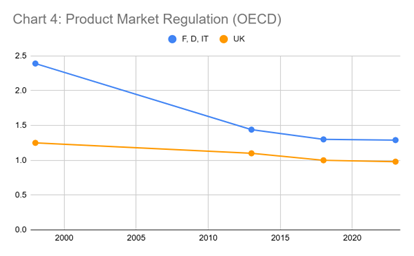
I am of course all in favour of better planning systems, lighter regulation, freer labour markets, lower barriers to enterprise, and all the rest of it. Every country has its specific blockages. In Britain, our planning regime is an obvious example. Supply-side reform will help, certainly. But it is not obvious, taking Europe as a whole, as the chart shows, that this is the specific explanation for the problems since 2008. Since then, the main forces depressing growth across the continent have been taxation, spending, and energy. Those are the phenomena that need to be tackled.
The wider issues
But, as I said at the start, that’s not all. And here is where I part company with the analysis of some free marketeers, and even more with some libertarians’. I do not believe our problems are just about economics. Culture matters too.
As I have said before, I believe that on a historical perspective Europe’s and the West’s economic success is fundamentally related to the emergence of the modern nation state. It is no accident that the great drive to success in the late eighteenth and nineteenth centuries happened first in the traditional existing nation states, and spread with nationalism across the continent. In short, nation-state formation and industrialisation proceeded to a significant extent in parallel.
That was not coincidence. Free markets require more than contracts and prices. They require a willingness to experiment, to change, to disrupt traditional ways of doing things. They require people to accept churn, uncertainty and unequal outcomes. That will not happen unless people feel they are part of a broadly cohesive community; unless they believe that that community can provide collective protection against the worst risks; and unless they think it is well governed, so that entrepreneurialism pays off rather than being arbitrarily punished. It also requires them to know that they can adjust course and solve problems as they emerge - that the democratic process genuinely means something and that elections can change things.
Unfortunately, what we are seeing in Europe is the gradual decomposition of the nation state, under two main pressures.
The first is the transfer of powers to Brussels: the steady disempowerment of national decision-making, and the promotion from above of particular ideological assumptions about government, economics and society. All this has happened without any true replacement at EU level by a European state capable of commanding democratic loyalty. Power has moved upwards, but legitimacy has not followed it, and the democratic link to national electorates has disappeared somewhere in the transition.
The second pressure is the large-scale migration, into at least some of our countries, of people from cultural backgrounds very different from our own, with social norms very different from our own, combined with a wilful blindness of Western elites about the challenges this poses for integration. This process is changing what existing citizens think of as their country, is requiring the creation of new and unpopular national stories, and is undermining the bargain upon which national welfare states rest. In short it is starting to undermine the factors which make a nation state an effective arena for politics and economic development.
Both these pressures are affecting the cultural, political, and democratic norms that have hitherto regulated nation states in Europe. The political and economic bargains on which they are based are beginning to fray. If, as I argue, the nation state and economic modernisation are closely linked, then you must expect economic growth to be affected if the nation state starts to decay. And that is exactly what we see.
I believe that solving the cultural and political problems has to go hand in hand with solving the economic ones. That is why our situation is worse than in the last great run of crises in the 1970s. Today, we face economic problems for sure, but we also have a deeper uncertainty about who we are, our systems of governance, and whether our countries still possess the solidarity needed for democratic capitalism to work. These things need to be resolved too.
So can free markets save the West? Yes - but not on their own, and not in abstraction from the society in which they operate. We need leaders willing to shrink the state, end the net zero madness and restore abundant energy. We need leaders willing to revive national democracy, rebuild cohesion and defend the culture of the nation state. We need leaders who understand that prosperity is not produced by bureaucracy, and that a civilisation survives only when it still believes in itself. If we don’t find them, decline will not merely continue, it will become our settled condition. The West can still be saved. We know how. But where are the leaders who will take this task on?
 |
|