



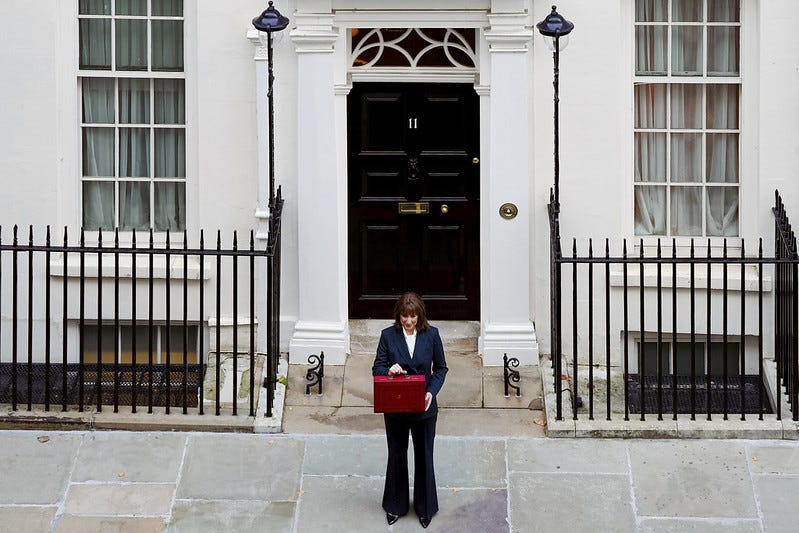
It is Rachel Reeves’ Spring Statement today.
Normally the spring statement is a significant government event. This time, though, we have been told to expect nothing special by way of fiscal or broader economic policy changes. In one sense that is good. Every economic policy statement by this government has made things worse. No change is at least an improvement on that.
But it really isn’t enough. In an ideal world Reeves would be setting out a plan to deal with this country’s serious economic problems, some of which are of her own making, some going much deeper.
What should she be saying instead? What is my ideal Spring Statement? What does the country need?
Well it is very straightforward. It brings together many of the things we have been saying for some time. We even have a ten-point plan for her.
Tax and Spend: Acknowledge that taxation and spending are now too high, announce an intention to get both down by 1% of GDP a year (about £30bn) in what remains of this Parliament. As part of this, promise to eliminate the many “cliff edges” in our tax system that discourage work. Meanwhile, stop implementation of tax increases being introduced in April.
Pensions: Promise a new mechanism to replace the state pension triple lock, maintaining incomes for pensioners at a constant share of GDP. Reduce the generosity of future state defined-benefit pensions, to avoid the constant growth of liabilities.
Net Zero: Announce an end to the net zero policy. Promise to repeal the Climate Change Act. Meanwhile, freeze renewables investment, liberalise North Sea oil exploration and reduce the punitive North Sea tax burden, and legalise fracking. Promise an immediate halt to solar installation in the UK on anything other than domestic premises and scrap the ban on new petrol cars. The Government might well need more short-term measures here too as a result of the war in Iran: notably, temporary reductions in petrol fuel duty.
Cost of jobs: Halt the entry into force of the Employment Rights Act and the planned increases in the minimum wage for the rest of this Parliament.
Planning and housing: Promise another, this time genuinely liberalising, liberalising Planning Bill. Scrap requirements for affordable housing. Abolish the new rules on building regulation for buildings over 18m high. Halt the entry into force of the Renters Rights Act so as to avoid further harm to the rental market.
Infrastructure: Promise Enabling Acts to give the government all necessary powers to get built a defined set of infrastructure projects, including the Heathrow third runway and new nuclear power stations.
The NHS: Announce a Royal Commission to investigate the various European health systems and propose a mechanism to change the NHS into such a system over a 10-year period.
Farming: Fully reverse the inheritance tax changes for farmers and promise a major reduction in the regulatory burden on farming, in return for gradual reductions in environmental subsidy.
Tariffs and trade: Reduce to zero all tariffs on goods which Britain does not itself produce except where there is a clear national security justification.
The EU “Reset”: End negotiations on all aspects of the EU “reset” that involve alignment with EU rules without a say, that is, at least the food standards and carbon / electricity market plans. Reverse the decision to join Erasmus (saving nearly £600m this year and more in future years).
Of course we know that none of this will happen. The government’s only real strategy is to talk about economic growth while increasing taxation, spending, and regulation year on year. But doing that is a choice. There are many things which could be done which would increase growth, prosperity, and wealth in Britain. Not doing them is a deliberate choice - a choice to get gradually poorer every year. Until this reality is faced, Britain will continue to face economic decline.
 |
|
She should be saying “i’m out of my depth. I have no vision or coherent strategy so im standing down”.